

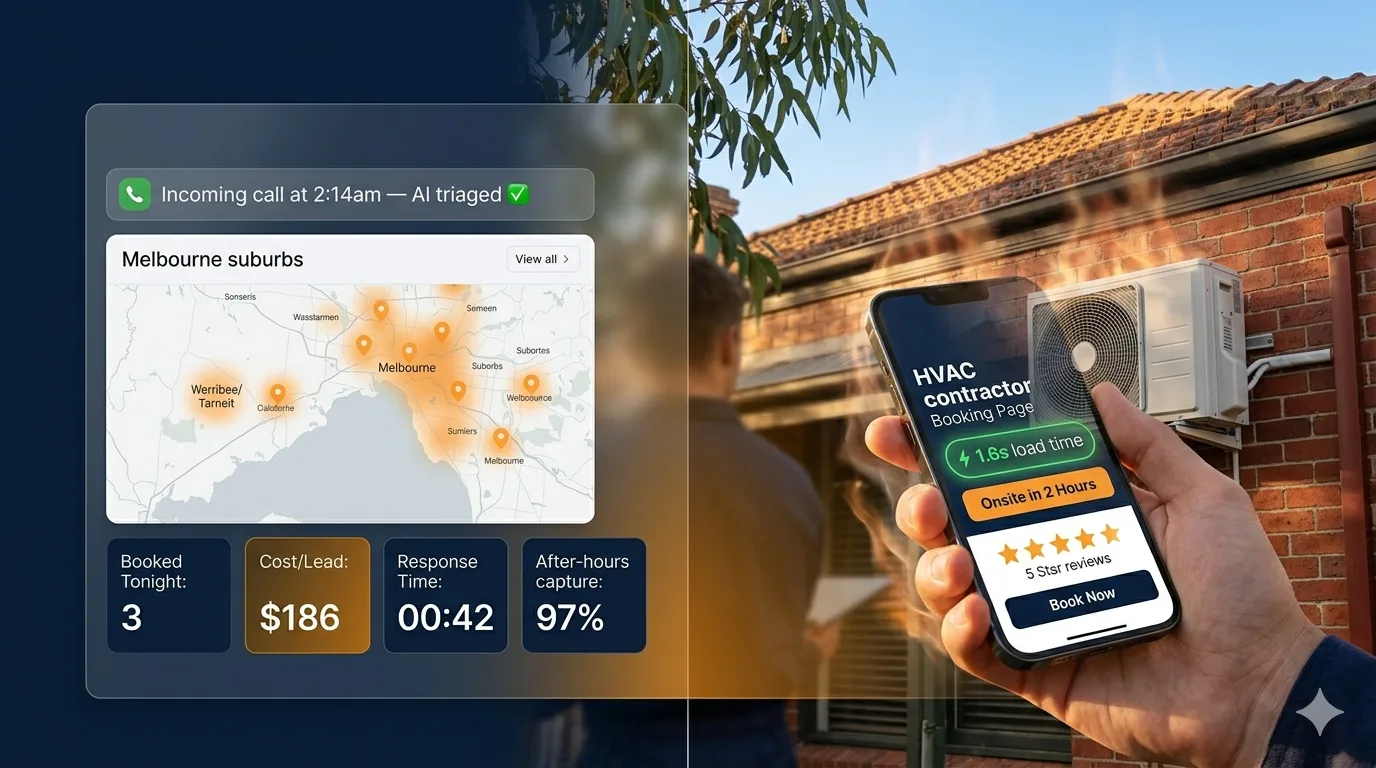
Choosing a marketing company for HVAC contractors in Melbourne isn’t a branding exercise anymore it’s a commercial survival decision.
When an air conditioner dies in a 38°C heatwave, the homeowner doesn’t ask for recommendations. They grab their phone, type “emergency AC repair near me”, and tap the first result that loads fast and looks credible. If you aren’t there, you don’t get the call — and the $5,000 installation goes to your fastest competitor.
At Webco, we help Australian HVAC contractors dominate local search results, AI engine citations, and after-hours lead capture — so the phone rings for your business when the heat (or cold) hits. This is the 2026 blueprint: what’s changed, what now works, and the specific systems booking the highest-ticket HVAC jobs in Melbourne right now.
Why 'Good Enough' SEO Just Lost to Generative AI
Traditional HVAC SEO — keywords, backlinks, monthly blog posts — still matters in 2026, but it’s no longer enough. Google, ChatGPT, Perplexity and Gemini now decide who gets the call by rewarding contextual authority: your business acting as the definitive local knowledge source on HVAC in your service area.
The commercial reality for Melbourne HVAC contractors in 2026:
AI search pre-qualifies leads. Rising labour costs mean you can’t afford tyre-kickers. Generative engines surface businesses that answer specific questions — “Who replaces heat pump hot water in Werribee with VEU rebates?” — and skip the ones serving generic content.
Your competitor is probably already there. The shift from gas to electric heat pumps under Victorian Government electrification mandates has created a massive knowledge gap. The HVAC contractor who fills it — with clear, current, structured content — wins the bookings.
Content freshness is now a ranking weapon. Perplexity and Gemini prioritise data updated every 48–72 hours. A static “About Us” and two-year-old blog archive is a sinking ship in AI search.
Most trade marketing is still built for 2020 playbooks. A proper marketing company for HVAC contractors in 2026 builds for AI citation — so when a homeowner asks Siri, ChatGPT or Google AI Mode “who’s the best emergency HVAC technician near me?”, your business name is the answer that gets spoken aloud.
“Within eight weeks of the Webco rebuild, we were getting booked 2am emergency calls while the van was parked. AI text triage captures them, qualifies them, and slots them straight into ServiceM8. We haven’t missed an after-hours heatwave lead since.”
— HVAC contractor, Western Melbourne
Dominating the Melbourne HVAC Landscape: VEU Rebates & Electrification
Generic national marketing agencies fail to capture Melbourne HVAC leads because they ignore the local regulatory drivers that decide which businesses customers actually book. In 2026, growth for Victorian HVAC contractors is driven by three overlapping mandates: the Victorian Energy Upgrades (VEU) program, Solar Victoria rebates, and the gas-to-electric heat pump transition.
Why VEU-positioned HVAC businesses are winning:
3x higher search demand in high-growth electrification suburbs like Werribee, Tarneit, Richmond and Brunswick compared to generic city-wide HVAC searches
Higher average job value — VEU-backed heat pump upgrades typically sit in the $6,000–$12,000 installation bracket, not the $300 service call range
Pre-qualified buyer intent — customers searching “VEU heat pump rebate installer” already know roughly what they want and what they’ll pay
Webco positions HVAC businesses as the Certified Electrification Specialist in their target suburbs — through VEU-specific landing pages, structured FAQ content covering the January 2026 fee increases, and Google Business Profile optimisation that signals rebate expertise to both Google and the homeowner.
The 'Panic Click': Why Speed Is Now a Revenue Issue, Not a Tech Issue
Roughly 70% of HVAC trade leads are “Panic Clicks” — mobile users in crisis who will hire the first authoritative contractor whose site loads fast and looks trustworthy. They don’t compare five quotes. They don’t read reviews in depth. They tap the first result that meets three thresholds in under 60 seconds: fast, credible, clearly open.
If your site takes more than 3 seconds to load on 4G, you’ve just referred that $5,000 ducted system job to a competitor. The five systems below are how we convert Panic Clicks into booked jobs — and how a proper marketing company for HVAC contractors should be stacking your commercial defences.
1. Sub-1.8 Second Load Time on Mobile (Every Second Costs 20% Conversion)
Google’s Core Web Vitals are a confirmed ranking factor. More importantly, every extra second of mobile load time drops conversion by roughly 20%. We treat site speed as a commercial lever, not a tech checkbox.
Target: LCP under 1.8s, INP under 200ms, CLS under 0.1 on mid-range Android devices — not just on a developer’s MacBook
Image optimisation and lazy loading so the hero fold paints instantly even on patchy 4G
Strip third-party scripts — most HVAC sites carry 40+ tracking scripts that each add 100–300ms of lag
Outcome: Panic Clicks land on a page that’s already interactive before they can second-guess their choice.
2. The Trust Escalator: Scan-Ready Signals That Convert Fear to Booking
Panic-clickers don’t read — they scan. In the first 5 seconds they make a go/no-go decision based on visual trust signals. Miss them and they bounce back to the Google results.
Real team photos in branded uniforms — not generic stock imagery of tools or ductwork
VBA registration number and ARC refrigerant handling licence visible above the fold, not buried in the footer
Fixed-price repair guides and “onsite in 2 hours” badges that remove pricing anxiety before they call
Recent Google reviews with photos embedded live on the page, not just a star rating
Outcome: The customer moves from “crisis” to “booked” in under 60 seconds — without ever comparing to another HVAC provider.
3. Mobile-First, Thumb-Friendly Design (The 12-Field Form Is Dead)
88% of consumers say they won’t return to a website after a bad mobile experience. Your slow, cluttered mobile site isn’t just an inconvenience — it’s your fastest competitor’s best lead source.
No pinch-to-zoom — everything readable at arm’s length on a 6-inch screen
No 12-field forms — just name, phone, suburb, issue, and a one-thumb submit button
Persistent click-to-call button that stays visible while the user scrolls, not hidden behind a burger menu
“Book now” and “Call now” as two equal-weight CTAs for customers who prefer each channel
Outcome: The user books or calls with a single thumb, one-handed, while the aircon is still dripping on the kitchen floor.
4. AI Lead Automation: Never Miss a 2am Emergency Call Again
The old way: you wake up to a voicemail at 6am, call back, and the homeowner already booked someone else. The new way: AI voice and text agents handle roughly 80% of after-hours interactions instantly — qualifying, scheduling and routing into your job management system before you’re out of bed.
24/7 lead capture without hiring a night dispatcher — AI agents answer, classify emergency vs quote request, and book urgent jobs straight into ServiceM8 or Simpro
Text-first response wins after hours — most panic-clickers won’t answer an unknown number at 11pm but will reply to a text within 2 minutes
Conversion lift of 30–40% on after-hours enquiries when AI responds immediately versus a callback next morning
Outcome: Hustle doesn’t scale — systems do. If you’re still relying on your personal phone after hours, you’re not a business owner, you’re an on-call employee.
5. Structured Data & Schema for AI Citation (Invisible to Humans, Critical to Machines)
AI engines like ChatGPT, Perplexity and Google AI Mode don’t read your website the way a human does — they parse structured data. Without the right schema, your business is invisible to the engines deciding who gets cited in the answer.
LocalBusiness + HVACBusiness schema with full service area coverage, hours, licence numbers, and accepted payment types
FAQ schema answering “who”, “what”, “how much” and “how fast” questions in natural language — the exact phrasing AI engines extract as citations
Service and offer markup for specific HVAC jobs (ducted heating install, split-system repair, VEU heat pump upgrade) so each service surfaces independently in AI results
Outcome: When a Melbourne homeowner asks “who’s the fastest AC repair in Werribee?”, the AI has the structured evidence to say your business — with specifics it can’t invent about a competitor.
Recurring Revenue: Stop Chasing One-Off HVAC Repairs
The biggest leak in most HVAC businesses isn’t a refrigerant line — it’s the failure to turn a one-off repair client into a recurring maintenance client. Shoulder seasons (spring and autumn) are quiet for most contractors because there’s no system for repeat work. The ones running hot year-round have automated the follow-up.
The automated sequence Webco builds for HVAC contractors:
Post-repair SMS: “Your split system is fixed. Want a reminder for its annual service in 11 months? Reply YES.” — set and forget, compounding every job.
VEU rebate check-ins for past heat pump install clients, triggered automatically when new rebate top-ups are announced — positioning you for the next upgrade before a competitor gets the quote.
Maintenance agreements as the default offer — a small monthly fee including priority dispatch and annual filter/coil checks. Smooths the cash-flow rollercoaster.
ROI proof: An HVAC client with 200 active maintenance agreements generates $60,000–$100,000 in predictable annual revenue. That’s two quiet months paid for before shoulder season even starts.
What's Changed in the Last 12 Months (And Why Waiting Costs You)
Three shifts are already reshaping HVAC lead generation in Melbourne. HVAC contractors who adapt in 2026 compound for years. The ones who wait hand market share to the ones who moved first.
Generative AI now mediates 40% of local service searches. Roughly 40% of local service queries now trigger an AI summary (Google AI Overviews, AI Mode, ChatGPT Search, Perplexity). If your business data isn’t structured for extraction via schema and clean FAQ content, you’re invisible — not just lower-ranked, genuinely absent from the AI answer.
VEU targets and fee increases landed in January 2026. Higher compliance costs have confused homeowners. The HVAC contractor who explains the changes clearly — on their website, in their Google Business Profile Q&A, and inside AI search results — wins every time. Confusion converts to whoever resolves it first.
Customer patience has collapsed to zero. Acceptable response time for HVAC enquiries has dropped from 2 hours to 15 minutes over the last 18 months. AI automation isn’t a luxury upgrade — it’s the minimum viable standard for staying in the game.
Your move: keep hoping the phone rings — or install a system that captures Panic Clicks, automates after-hours triage, and turns every one-off repair into recurring annuity revenue.
The 30-Second HVAC Marketing Audit (Plus FAQs)
Run this on your business today. If you can’t answer “yes” to all three questions below, you have a measurable growth leak.
Does your HVAC website load in under 2 seconds on a mobile phone? Test it right now on 4G, not your office Wi-Fi. Use PageSpeed Insights or WebPageTest.
Does your Google Business Profile have a complete Q&A covering VEU rebates and VBA / ARC compliance? If the answers aren’t there, both Google and homeowners assume you’re not the expert.
Do you have an automated system capturing and responding to leads between 8pm and 8am? If the answer is “I check my phone when I wake up”, you’re losing roughly 30–40% of after-hours enquiries to competitors with AI triage in place.
Frequently Asked Questions
How can I get my HVAC business mentioned by ChatGPT or Perplexity?
To rank in AI-driven searches, structure your site with LocalBusiness and FAQ schema, answer natural-language questions directly (“Who is the fastest AC repair in Werribee?”), and refresh core content every 2–3 days. AI engines favour “quote-ready” information blocks they can extract verbatim, and Perplexity specifically rewards sites with recent update timestamps.
What is a ‘Panic Click’ and why does it matter for HVAC?
A Panic Click is the urgent search behaviour that happens when a critical system — aircon, heating, hot water — fails. These users don’t compare options; they tap the first authoritative result on their phone. Webco optimises HVAC sites for Panic Clicks by ensuring sub-1.8 second load times and high-intent CTAs like “Onsite in 2 Hours”.
Are VEU rebates still effective for HVAC marketing in 2026?
Yes. While VEU targets for 2026 are set at 4.4 million certificates, focus has shifted to larger electrification upgrades (heat pumps, ducted systems). Positioning your HVAC business as an expert in VEU rebates and the January 2026 fee changes establishes the authority signals both Google and homeowners look for.
Why is mobile speed the ‘silent killer’ of HVAC leads?
88% of consumers won’t return to a website after a bad mobile experience. In an HVAC emergency, a slow site is a direct referral to your fastest competitor. Site performance is a revenue issue, not an IT issue — which is why we treat it as a commercial lever.
How does Webco differ from generic trade marketing companies?
Generic agencies report impressions and clicks. Webco reports booked jobs and revenue. We integrate HVAC marketing directly with AI-powered automation and CRM so growth scales without adding admin headcount.
Claim Your Free 20-Minute 'Panic Click Audit'
Because in a heatwave — or a cold snap — the phone only rings for the HVAC business that’s fast, trusted, and always open.
Webco’s offer, no fluff, no lock-in: we’ll run a free 20-minute Panic Click Audit on your current digital presence. You’ll get a written report covering your mobile speed score, AI citation readiness, Google Business Profile gaps, and after-hours lead capture status — with specific fixes, prioritised by revenue impact.
No obligation. No pitch for services you don’t need. Just a clear number: how many booked jobs you’re currently leaking, and which lever recovers them fastest.