

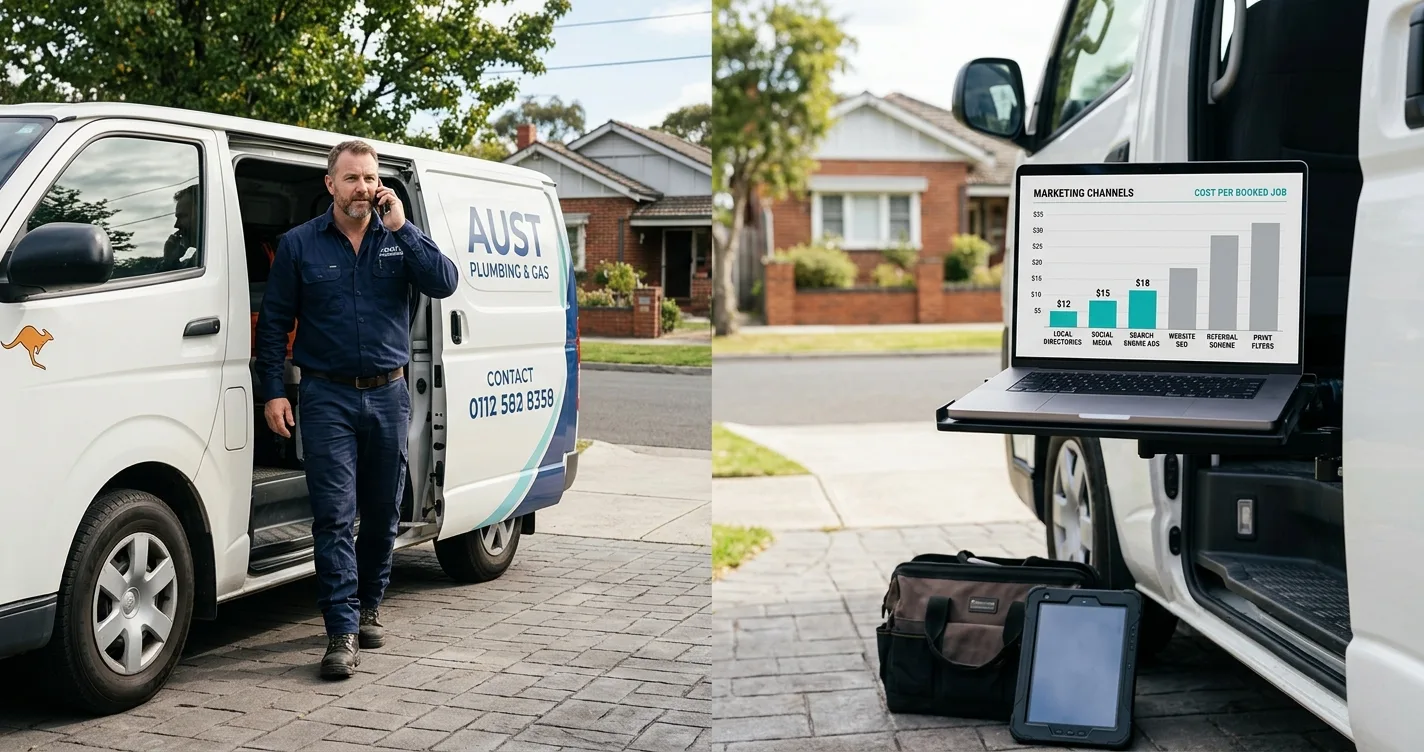
Ask ten Australian plumbers what a lead costs them and nine will quote a cost per click or a HiPages lead fee. That is the wrong number. A $30 lead that never books is more expensive than a $180 lead that turns into a $2,400 hot water install. Plumbing lead generation in Australia only makes sense when you measure it the way you run the rest of the business: by what it actually costs to put a paying job on the board.
Get this wrong and you burn a marketing budget on channels that look cheap per click and quietly resell your enquiry to three competitors. Get it right and you can predict, to the dollar, what next month’s booked jobs will cost you. This guide ranks the seven channels by that single number, with real Australian ranges.
Quick answer: Plumbing lead generation is the process of getting Australian homeowners and property managers who need a plumber to contact your business, then measuring each channel by cost per booked job rather than cost per lead. Ranked cheapest to most expensive, the seven channels are: review and referral velocity ($15 to $40), Google Business Profile and the Map Pack ($20 to $50), organic service and suburb pages ($25 to $60), Google Local Services Ads ($45 to $95), Google Search Ads ($60 to $130), Meta ads ($80 to $160), and lead marketplaces like HiPages ($110 to $220+).
The 7 Plumbing Lead Channels, Ranked by Cost Per Booked Job
Ranges below are Webco benchmark bands across Australian plumbing and gas accounts. Your real number depends on your close rate and average job value, which is exactly the point: two plumbers on the same channel can sit at opposite ends of the range.
Channel
Cost per booked job
Type
Review and referral velocity
$15 to $40
Owned
Google Business Profile and Map Pack
$20 to $50
Owned
Organic service and suburb pages
$25 to $60
Owned
Google Local Services Ads
$45 to $95
Rented
Google Search Ads
$60 to $130
Rented
Meta ads
$80 to $160
Rented
Lead marketplaces (HiPages)
$110 to $220+
Resold
The pattern is simple. The channels you own cost the least per booked job and get cheaper as they mature. The channels you rent cost more and stay flat. The channel that resells your enquiry to competitors costs the most of all.
Why Cost Per Booked Job Is the Only Number That Matters
Cost per booked job (CPBJ) is total channel spend divided by the number of jobs that channel actually put on your calendar. It rolls three things into one figure that clicks and leads hide: how well your website converts, how fast you answer, and how often you close.
Here is the maths that most agencies never show you. Say emergency plumbing clicks cost you $18 each, your landing page turns 15% of those clicks into phone calls, and you book half the calls that come in:
Before:
$18 ÷ 0.15 = $120 per enquiry
$120 ÷ 0.50 = $240 per booked job
Now lift your close rate from 50% to 65% and rebuild the landing page so it converts 22% instead of 15%:
After:
$18 ÷ 0.22 = $82 per enquiry
$82 ÷ 0.65 = $126 per booked job
Same channel, same ad spend, nearly half the cost per booked job. Nothing changed in Google Ads. Everything changed after the click. That is why cost per click is a vanity number and cost per booked job is the one you manage the business on.
The Channels You Own (Lowest Cost Per Booked Job)
Owned channels are assets. You build them once, they keep producing, and every new booked job lowers the average cost instead of repeating it.
Review and referral velocity
The cheapest booked jobs in plumbing come from your own past customers and their reviews. Review volume and recency also feed your Map Pack ranking, so a review system pays twice. Automate an SMS review request after every completed job and you build a compounding asset for the price of a few text messages.
- Action: Trigger an SMS review request the moment a job is marked complete in your CRM.
- Target: 3 to 5 fresh Google reviews per week, sustained for 90 days.
- Tool: Any CRM with SMS automation (Webco runs this on GoHighLevel).
Google Business Profile and the Map Pack
Most “plumber near me” searches never scroll past the Map Pack, the three-business block at the top of local results. A complete, active Google Business Profile with suburb-level service areas is the highest-return owned channel for local emergency work, and it costs optimisation time, not a per-lead fee.
- Action: Set postcode-polygon service areas, correct categories, and weekly posts.
- Target: Top three in the Map Pack for your core suburbs.
- Tool: Google Business Profile, kept live weekly, not set-and-forget.
Organic service and suburb pages
One page per active service area captures the long-tail searches marketplaces charge you for. It is slower to build than ads, but once a “blocked drain [suburb]” page ranks, the leads arrive with no per-click cost. This is the backbone of durable local SEO for plumbers.
- Action: Publish one indexable page per core service and per priority suburb.
- Target: Page-one rankings for suburb-plus-service terms within 3 to 6 months.
- Tool: A fast, mobile-first site with click-to-call above the fold.
The Channels You Rent (Fast, but They Stay Expensive)
Rented channels are how you buy cash flow while the owned channels mature. Run them, but never mistake them for a foundation. The day you stop paying, the leads stop.
Google Local Services Ads
Local Services Ads sit above the normal Google Ads block with a Google Guaranteed badge, and you pay per lead rather than per click. For plumbing they convert well because the intent is high, but the cost per booked job climbs fast in competitive capitals.
Google Search Ads
Standard Google Ads for plumbers put you at the top when someone searches “burst pipe” or “24 hour plumber” at 9pm. High intent, fast to launch, and the single biggest driver of same-day emergency work. The catch is a tight negative-keyword list, because without one you pay for DIYers, apprentices and wholesale searchers.
Meta and Facebook Ads
Meta ads are weak for “I need a plumber now” and strong for planned-project demand: bathroom renovations, hot water replacements, gas fit-outs. Use them to fill the pipeline between emergencies and to retarget people who visited your site but did not call.
The Channel That Resells Your Leads (Highest Cost Per Booked Job)
Lead marketplaces: HiPages, Airtasker and Oneflare
Marketplaces feel cheap because the entry fee is low, but they carry the highest cost per booked job of any channel for one reason: the same enquiry is sold to three to five plumbers at once. You are not buying a lead, you are buying a race to the bottom on price, and you pay whether you win the job or not. Compared side by side, building your own pipeline usually beats buying marketplace leads within a few months. The maths only gets worse as your competitors bid the shared leads up.
What Is Changing in Plumbing Lead Generation in 2026
Speed to lead decides who wins the job
In emergency plumbing the first business to answer usually wins. A missed call at 8pm is a booked job for the next plumber on the page. This is why AI call answering for plumbers has moved from novelty to necessity: it captures and qualifies after-hours enquiries the moment they land, so a paid click never dies in a voicemail box.
AI Overviews reward structured, cited answers
Google AI Overviews and tools like ChatGPT now answer many “how do I get more plumbing jobs” style searches directly. They cite pages that give clear numbers, named channels and worked examples, not vague advice. Plumbing businesses that publish specific, structured content are starting to appear inside those answers, which is a lead channel that did not exist two years ago.
The winning plumbing marketing plan in Australia is not one channel. It is rented channels funding cash flow now while owned channels drive the cost per booked job down over the next two quarters.
How to Lower Your Cost Per Booked Job
Bridge from measuring to fixing with four moves, in order of return.
- Track every enquiry back to source. Add call tracking and form tracking so you know the cost per booked job of each channel, not just the cost per lead.
- Fix what happens after the click. A sub-3-second mobile site with click-to-call above the fold lifts conversion on every paid channel at once.
- Answer faster. Capture and qualify after-hours enquiries automatically so no paid lead dies in voicemail.
- Shift budget toward owned channels each quarter. As reviews, Map Pack and suburb pages mature, move spend off marketplaces and watch the blended cost per booked job fall.
If you want this measured properly across your own accounts, our full plumbing marketing in Australia playbook shows how the channels connect, and a free 30-minute audit will show you exactly what your current cost per booked job is by channel. No lock-in, no rented leads, just the number that actually runs your business.
Frequently Asked Questions
What is the best lead generation channel for plumbers in Australia?
For most Australian plumbers the best long-term channel is a combination of Google Business Profile, the Map Pack and a review-velocity system, because these carry the lowest cost per booked job and get cheaper as they mature. For immediate cash flow, Google Search Ads and Local Services Ads book jobs within days. The strongest plumbing lead generation setup runs paid channels for speed while owned channels compound underneath them.
How much do plumbing leads cost in Australia?
Plumbing lead costs in Australia vary widely by channel and city, which is why cost per booked job matters more than cost per lead. As a rough guide, owned channels like SEO and Google Business Profile deliver booked jobs at roughly $20 to $60 each once mature, paid channels like Google Ads and Local Services Ads land around $45 to $130, and lead marketplaces such as HiPages sit highest at $110 to $220 or more because the enquiry is resold to several competitors.
Are HiPages and Airtasker worth it for plumbers?
Marketplaces like HiPages, Airtasker and Oneflare can fill short-term gaps, but they carry the highest cost per booked job of any channel because the same enquiry is sold to three to five plumbers at once, forcing a price war you pay to enter whether you win or not. Most plumbing businesses are better served building owned assets, a ranking website, Google Business Profile and reviews, that lower their cost per lead instead of repeating it every month.
How long does plumbing lead generation take to work?
Paid channels like Google Ads and Local Services Ads generate booked jobs within days of launch. Owned channels take longer: Google Business Profile and the Map Pack usually move within 6 to 12 weeks, and organic suburb pages compound from month three onward. Running both in parallel means paid work funds cash flow while your owned channels build a permanently lower cost per booked job.
What is the biggest mistake plumbers make with lead generation?
The biggest mistake is optimising for cost per click or cost per lead instead of cost per booked job. A channel can look cheap per click and still be your most expensive source of work if the leads do not convert. The second biggest mistake is renting all your leads from marketplaces and never building owned assets, so every job costs the same as the last one instead of getting cheaper over time.
See Your Real Cost Per Booked Job, by Channel
Webco builds owned and rented plumbing lead channels into one system measured on cost per booked job, not cost per lead. We track every enquiry back to source, fix what happens after the click, and shift budget toward the channels that get cheaper as they mature. No lock-in, no rented leads.