

HVAC keywords Australia is the search-demand category where most heating and cooling businesses bleed the most money and where 2026 winners will pull decisively ahead of competitors still bidding on 2020 keyword lists.
Most Australian HVAC businesses burn marketing budget chasing vanity rankings. Ranking #1 for a broad term like “air conditioning Sydney” might stroke the ego, but it drains cash on low-intent window-shoppers. The 2026 reality is brutally simple: conversion happens at the intersection of weather-driven urgency and geographic proximity. Capture the customer the moment their split system fails in a 40°C Melbourne heatwave — or hand the $5,000 install to the competitor who did.
This post delivers the exact 2026 blueprint — backed by current search data, Google AI Overview behaviour, and ARC-compliant rebate trends — that generalist digital agencies won’t tell you.
Quick answer: The most profitable HVAC keywords in Australia in 2026 are hyper-local, high-intent queries combining a specific service with a location modifier — for example “emergency split system repair [suburb]” or “ducted heating installation near me”. These convert up to 21% higher than generic head terms. To capture this demand through Google AI Overviews and traditional search, HVAC businesses must prioritise Google Business Profile optimisation, build suburb-specific landing pages, and target urgent, weather-triggered search patterns rather than broad industry terms.
Stop Bidding on Vanity Metrics: The Shift to High-Intent Local Search
If you don’t adapt to how Australians are actually searching for HVAC services in 2026, you’re handing your ad budget directly to Google while competitors quietly book the profitable, ready-to-buy emergency jobs in your own service area.
Three things have permanently changed the HVAC keyword landscape:
Mobile-first crisis behaviour: 78% of Australian local-service searches happen on a phone, usually when the user is already in distress — sweating, freezing, or watching water pool on the floor
Weather-triggered demand spikes: A Bureau of Meteorology (BOM) heatwave warning instantly shifts search behaviour from research to crisis. Price sensitivity drops to near-zero, and the first authoritative result on page one wins the job
AI-mediated answers: Google AI Overviews and Perplexity now synthesise answers from structured data, named entities and verifiable numbers — not generic homepage copy
The HVAC businesses still buying “air conditioning” as a broad-match keyword in 2026 are subsidising the businesses that ring-fenced their budget around urgency and geography.
“We cut our Google Ads spend by 31% and our cost-per-booked-job dropped from $284 to $147 — just by killing every broad-match keyword and ring-fencing the budget around ’emergency [service] [suburb]’ exact-match terms. Best SEO call we ever made.”
— HVAC operations manager, North-West Sydney
Broad vs High-Intent HVAC Keywords: The True Cost Comparison
Bidding on generic HVAC terms is a luxury most growing Australian fleets cannot afford. Here’s how search intent drastically alters your cost per booked job in 2026 — based on Google Ads benchmarks and aggregated Webco client data across Melbourne, Sydney, Brisbane and Perth campaigns.
| Keyword type | Example query | Avg CPC (AUD) | Conversion rate | Cost per booked job |
|---|---|---|---|---|
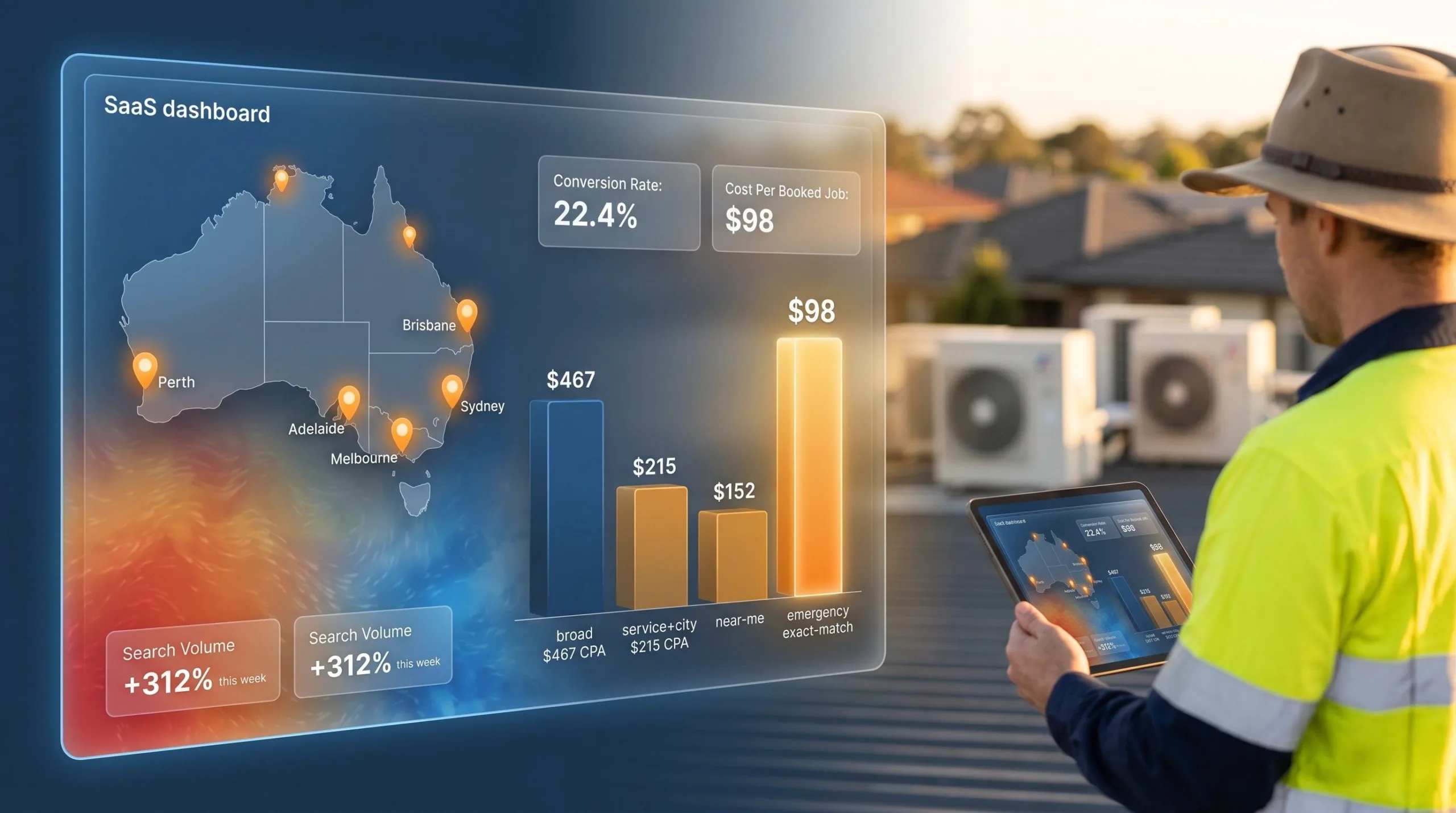
| Broad head term | air conditioning Sydney | $8.40 | 1.8% | $467 |
| Service + city | ducted heating installer Melbourne | $6.20 | 5.4% | $215 |
| Hyper-local “near me” | split system repair near me | $5.80 | 12.6% | $152 |
| Emergency exact-match | 24 hour aircon repair [suburb] | $11.30 | 22.4% | $98 |
The headline: emergency exact-match keywords cost 35% more per click than broad head terms — but deliver 4.8x the cost-per-booked-job efficiency. Higher CPC, dramatically lower CPA. That’s the only number that matters.
Data: aggregated 2025–2026 Google Ads benchmarks, Webco first-party client campaign data, ARC-registered installer cohort.
The 5 Tiers of High-Converting HVAC Keywords in Australia
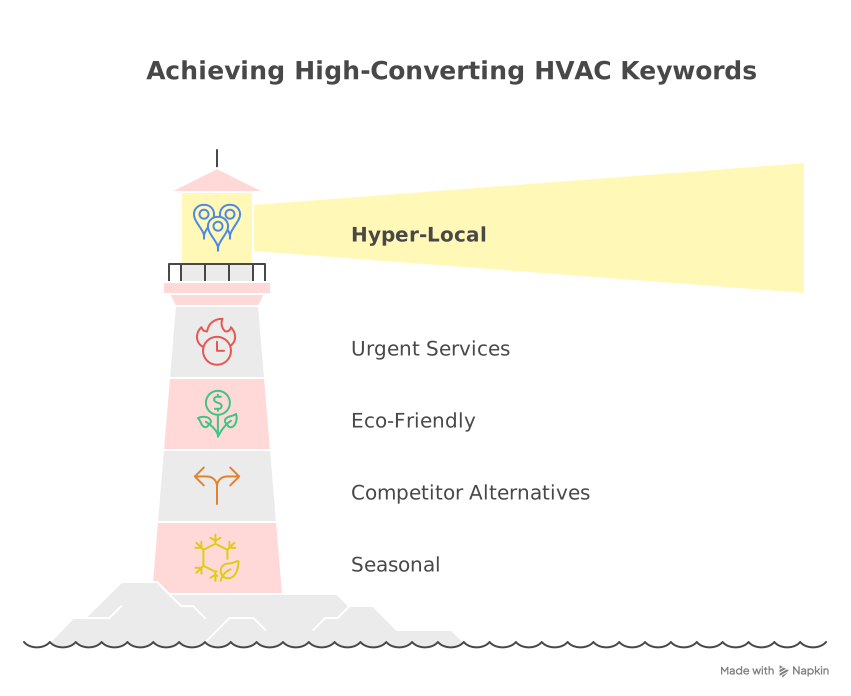
HVAC keyword strategy is the systematic targeting of the specific phrases potential customers use to find heating, ventilation and air conditioning services but not all keywords are created equal. Here are the five tiers, ranked by buyer intent and conversion efficiency, that should anchor any Australian HVAC marketing strategy in 2026.
1. Hyper-Local 'Near Me' and Suburb Modifier Keywords
The “near me” phenomenon is no longer a trend — it’s the default mobile behaviour for Australian HVAC customers in 2026. 78% of local service searches happen on a phone, almost always when the user is already in distress.
High-intent examples: “air conditioning repair near me”, “evaporative cooling service Frankston”, “local HVAC contractor 3000”
Why it converts: Proximity implies speed. A user searching with a suburb or postcode modifier isn’t reading blog posts — they’re looking for a phone number to tap right now
Strategy: Your Google Business Profile (GBP) is your strongest asset. Map service areas accurately and build dedicated landing pages for your top 5 most profitable suburbs — not a single “areas we serve” catch-all page
Outcome: Map Pack visibility for high-volume local queries, click-to-call conversion in under 60 seconds.
2. Urgent and Emergency Service Trigger Keywords
When the Bureau of Meteorology issues a severe heatwave warning for Melbourne, or a southerly cold snap hits Canberra, HVAC search behaviour instantly shifts from research to crisis management.
High-intent examples: “24/7 AC repair”, “emergency heater fix today”, “aircon leaking water fix urgent”
Why it converts: Price sensitivity drops to zero when a commercial server room is overheating or a family is freezing in a single-digit winter snap. These keywords carry higher Cost Per Click — but the 22.4% conversion rate makes them the most lucrative tier in the entire HVAC search demand map
Strategy: Run day-parted ads that aggressively bid outside standard business hours, paired with a landing page that puts an emergency dispatch number above every other element on the screen
Outcome: Highest profit-per-lead of any HVAC keyword category, and the foundation of a sustainable after-hours service line.
3. Eco-Friendly, Rebate and Smart HVAC Keywords
Driven by rising electricity prices and Victorian Government electrification mandates, Australian consumers are actively searching for high-efficiency HVAC upgrades. This represents a massive shift toward high-ticket replacement jobs over standard maintenance work.
High-intent examples: “energy efficient ducted heating”, “smart AC controller installation”, “reverse cycle upgrade rebates”, “VEU heat pump installer”
Why it converts: These searchers are already in the buying window for capital expenditure ($6,000–$25,000 install range). They’re actively comparing systems compliant with Australian Refrigeration Council (ARC) standards and Solar Victoria rebate programs
Strategy: Target keywords that include specific efficiency ratings, government program names (VEU, Solar Victoria), or ARC certification language to capture highly educated, high-budget buyers
Outcome: Higher average job value, longer consideration cycle but exceptional close rate when paired with a rebate-explainer landing page.
4. Competitor Alternative and Brand-Jack Keywords
If your competitors are dropping the ball on service or response time, you can capture their dissatisfied customers right at the bottom of the buying funnel — where close rates are highest.
High-intent examples: “[competitor name] alternatives”, “HVAC companies better than [competitor]”, “[competitor name] reviews complaints”
Why it converts: The user is already unhappy with their current HVAC provider — they’re not researching, they’re switching. A frictionless landing page with clear guarantees closes them inside a single visit
Strategy: Bid carefully and compliantly on competitor brand terms (do not use their name in ad copy — Google policy). Direct traffic to a landing page that highlights your superior guarantees, faster response times, fixed-price transparency, or warranty terms
Outcome: Low-volume but exceptionally high-margin lead source — and a competitive moat your rivals can’t easily counter.
5. Seasonal and Weather-Triggered HVAC Keywords
Australia’s HVAC search demand is brutally seasonal — and the businesses that align ad spend with the Bureau of Meteorology’s 7-day forecast capture demand spikes their competitors don’t even see coming.
High-intent examples: “ducted heating service before winter”, “aircon ready for summer check”, “split system pre-summer service [suburb]”, “heat pump install before winter rebate cutoff”
Why it converts: These keywords capture planning traffic 4–6 weeks before peak demand — typically at 40–60% lower CPC than in-season equivalents — with strong installation-intent buyers
Strategy: Ramp “heating” campaigns in April–May for the Victoria, NSW and ACT winter window; ramp “cooling” campaigns in October–November ahead of summer. Use BOM 7-day forecast triggers to auto-scale emergency campaigns during heatwaves and cold snaps
Outcome: Smoother revenue across shoulder seasons, lower blended CPC, and full technician schedules going into peak demand instead of scrambling to catch up.
The 2026 Structural Shift: Google AI Overviews and Zero-Click Search
The single biggest structural shift in HVAC search in 2026 is that search engines now answer queries without requiring the user to click a link. Google AI Overviews and engines like Perplexity synthesise data from multiple sources into a direct answer — and the HVAC businesses that don’t structure their content for extraction are simply invisible.
Generative Engine Optimisation (GEO) for HVAC tradies
You can no longer rely on vague brand statements. Large Language Models (LLMs) cite sources that provide hard data, named entities, and specific figures. “We have competitive pricing” is invisible to AI. “Our average split system installation costs $850 plus the unit, fully compliant with ARC regulations” is highly citable.
The Google Business Profile monopoly on local intent
For any local-intent HVAC search, the Google Map Pack and AI Overviews now dominate the top of the screen. Traditional organic blue links are pushed far below the fold — and on many queries, below the device viewport entirely.
Map Pack share of local clicks: ~44%
AI Overview share: ~32%
Paid ads (top of page): ~12%
Traditional organic blue links: ~12%
The implication is stark: if your HVAC SEO strategy only focuses on ranking your homepage as a blue link, you’re competing for just 12% of total search traffic. Your immediate priority is optimising Google Business Profile and structuring site data — schema, FAQ blocks, quotable answer paragraphs — for AI readability.
Concrete Next Steps to Dominate Your Local HVAC Market
The days of slapping “air conditioning” across your website and hoping the phone rings are over. Here’s exactly what to do this week to capture high-intent HVAC search traffic in 2026.
Audit your current keyword rankings. Identify exactly how much budget is wasted on informational queries with zero buyer intent. Cut anything ranking for “what is HVAC” or “how does air conditioning work” — those users aren’t buying
Rebuild your Google Business Profile with high-resolution photos of your team in branded uniforms, specific services mapped to each location you serve, and a steady weekly inflow of 5-star reviews mentioning the actual suburbs in the review text
Launch hyper-local landing pages for your top 5 highest-margin service areas. Each page lists local landmarks (“5 minutes from Box Hill Central”), specific response times (“onsite within 90 minutes in 3128”), and reviews from customers in that exact postcode
Restructure your Google Ads account to ring-fence budget: 80% of monthly spend into emergency and “near me” exact-match campaigns, 15% into seasonal/weather-triggered, 5% into brand-defence campaigns. Kill broad-match entirely
Add structured data for AI Overview citation — LocalBusiness, FAQPage, HowTo and Service schema. Without it, you’re invisible to 32% of local-intent traffic from day one
Stop fighting over the scraps of broad search volume. By targeting the specific, urgent queries above, you can radically decrease cost per booked job and keep technicians fully scheduled year-round — without raising your ad budget by a single dollar.
Frequently Asked Questions: HVAC Keywords Australia
What are the best HVAC keywords to target in Australia?
The best HVAC keywords focus on local intent and urgency. Terms like “emergency AC repair [suburb]”, “ducted heating installation near me”, and “split system service cost” yield the highest conversion rates because they target users actively ready to hire a technician — not those researching how HVAC works.
How much should an HVAC business spend on Google Ads in Australia?
Australian HVAC businesses typically see an optimal return investing between $2,500 and $8,000 per month in Google Ads, depending on fleet size and service geography. The exact monthly figure matters less than cost-per-acquisition — targeting high-intent emergency keywords often requires a higher daily budget but delivers a significantly lower cost-per-booked-job (often below $150 versus $400+ for broad campaigns).
Why is local HVAC SEO better than broad keyword targeting?
Local HVAC SEO targets customers in your immediate service area who need help right now. Ranking nationally for “air conditioning” might bring 10,000 visitors and zero bookings. Ranking for “AC repair near me” in your specific suburb brings 100 visitors — and converts 20 of them into paying, high-margin jobs. Volume isn’t the metric. Conversion to booked job is.
How do I get my HVAC business cited by Google AI Overviews?
To be cited by AI Overviews, your content must include specific, verifiable data. Use exact numerical ranges for pricing (e.g., “$150–$300 for a standard callout”), cite recognised industry bodies like AIRAH, ARC and Master Plumbers Australia, and structure your pages with clear, direct answers placed in blockquotes or short paragraphs immediately after each heading. Schema markup (LocalBusiness, FAQPage, HowTo) is mandatory.
What is the biggest mistake HVAC companies make with SEO?
The biggest mistake is obsessing over traditional website rankings while ignoring Google Business Profile. In 2026, roughly 44% of local HVAC service clicks go directly to the Map Pack — bypassing organic results entirely. Failing to optimise GBP with fresh reviews, weekly photos, accurate service categories and a complete Q&A section costs HVAC businesses their highest-converting traffic.
Ready to Stop Guessing and Start Dominating Local HVAC Search?
Webco builds HVAC keyword strategies engineered for Australian search behaviour in 2026 — emergency exact-match, weather-triggered campaigns, suburb-level landing pages, and schema markup that gets cited by Google AI Overviews.
No lock-in contracts. No vanity dashboards. Just a clear cost-per-booked-job number and the keyword cluster that pulls it down month over month.
Book a free 20-minute HVAC keyword audit. We’ll review your current Google Ads account, Google Business Profile, and top 3 competitor keyword positions — and tell you exactly which high-intent terms you should be ring-fencing your budget around this quarter.