

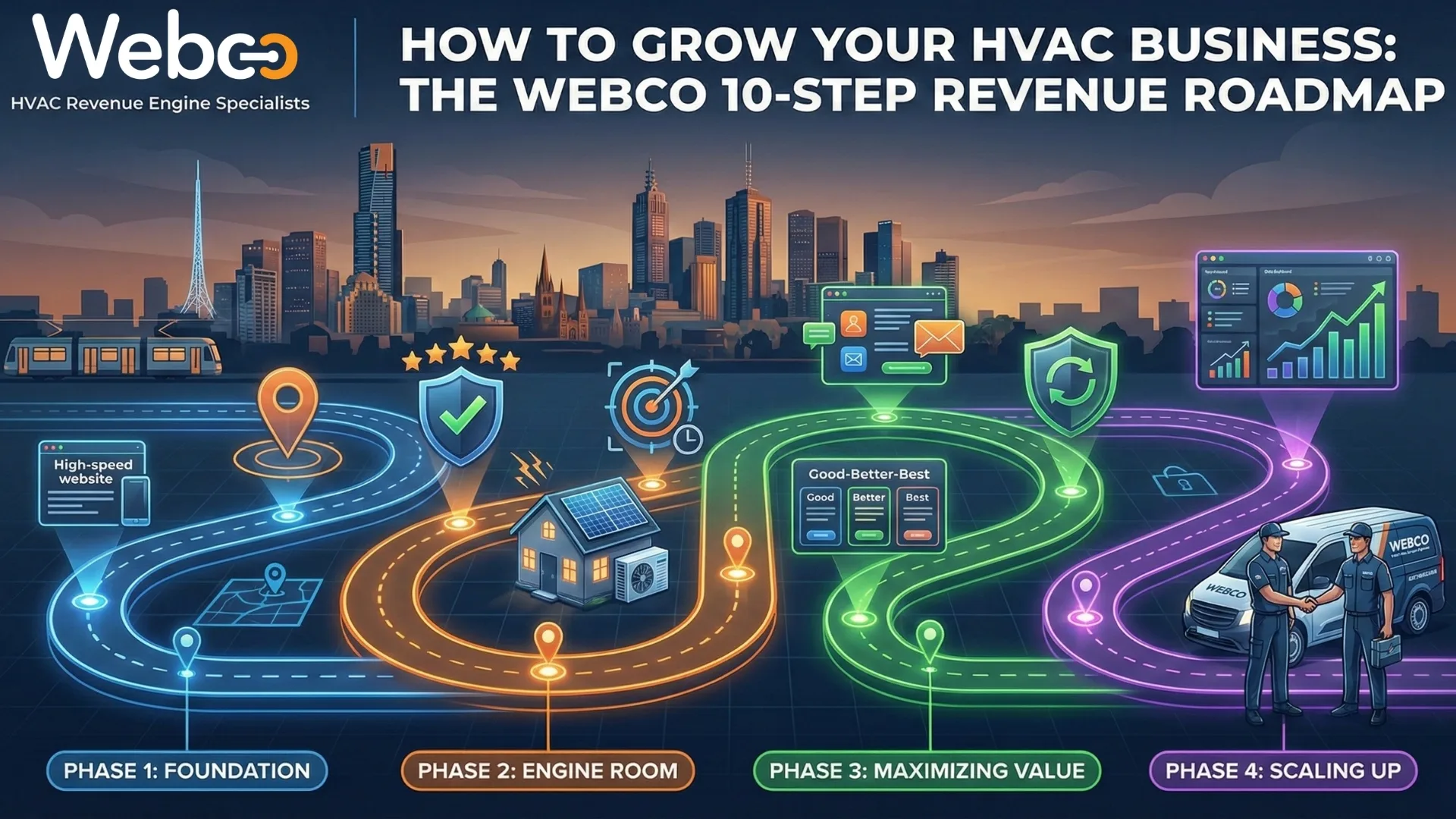
- 1. Dominate Your Local Suburbs First
- 2. Capture High-Intent Keywords
- 3. Precision Google Ads (The Immediate Tap)
- 4. Build a Recurring Revenue Engine
- 5. Build Strong Brand Signals
- 6. Use Reviews as a Growth Engine
- 7. High-Value Strategic Partnerships
- 8. Commercial HVAC Expansion
- 9. Systemise Operations (Kill the Hustle)
- 10. Scale With Your Team
- HVAC Growth FAQ
Growing an HVAC business in Melbourne isn’t just about “getting more jobs”—it is about engineering a scalable revenue engine. At Webco, we move beyond vanity metrics to focus on what actually matters: booked jobs and profit margins.
To dominate the 2026 market, you must transition from a “man in a van” to a market-leading operation. Here is the 10-step blueprint to scale your HVAC business.
1. Dominate Your Local Suburbs First
HVAC is hyper-local. Instead of trying to rank for all of Melbourne, Webco focuses on winning 1–3 high-value core suburbs. This reduces travel time, increases technician density, and boosts your local authority in “Near Me” searches.
Action: Fully optimize your Google Business Profile for categories like “Air Conditioning Contractor.”
Webco Standard: Upload real job photos and team updates weekly to signal “freshness” to AI search engines.
2. Capture High-Intent Keywords
Stop wasting budget on “research” traffic. Your SEO strategy must target Buyer-Intent Keywords where customers are ready to hire.
Target: “Ducted AC installation,” “Split system repairs near me,” and “Emergency 24/7 HVAC repair.”
The Difference: Create dedicated landing pages for every suburb and service. A fast, mobile-responsive site is non-negotiable for capturing high-urgency “Panic Clicks.”
3. Precision Google Ads (The Immediate Tap)
Google Ads is the only way to skip the queue and appear at the very top immediately. However, it must be structured for profit, not just clicks.
Webco Strategy: Separate your campaigns into “Installation,” “Repairs,” and “Maintenance.”
Control Your Data: Track your Cost Per Acquisition (CPA) and Revenue Per Job religiously. If you can control your cost per lead, growth becomes a predictable math problem.
4. Build a Recurring Revenue Engine
The real value of an HVAC business lies in its maintenance contracts. These provide stable cash flow during the shoulder seasons (Spring and Autumn).
The Goal: Every install should come with an annual servicing package.
Automation: Use automated SMS reminders to re-book past clients for filter replacements and system flushes.
5. Build Strong Brand Signals
Google and AI engines now reward established brands over generic websites. You need to prove you are a legitimate, trustworthy entity.
Signals: Highlight “Australian Owned & Operated” and “Serving Melbourne Since.”
Schema Markup: Use Organization and Service Schema to help AI engines like ChatGPT verify your business coordinates and credentials.
6. Use Reviews as a Growth Engine
In the trade sector, reputation is your most valuable asset. 74% of customers trust a business more after seeing positive reviews.
The System: Send a review request via SMS the moment the job is finished.
Leverage: Respond to every review (even the bad ones) and feature 5-star testimonials prominently in your marketing.
7. High-Value Strategic Partnerships
Don’t wait for the phone to ring—build a referral network.
Partners: Align with builders, real estate agents, property managers, and solar installers.
Commercial Upside: Property managers are the gold mine for recurring HVAC maintenance work.
8. Commercial HVAC Expansion
Residential builds your cash flow; commercial builds your stability.
Focus: Offices, gyms, retail stores, and warehouses.
Benefit: Commercial clients mean bigger contracts, longer retention, and predictable long-term income.
9. Systemise Operations (Kill the Hustle)
You cannot scale chaos. To grow, you must replace individual performance with repeatable systems.
Tech Stack: Implement a CRM like ServiceM8, SimPRO, or Tradify to handle scheduling, job tracking, and automated invoicing.
Automation: Webco integrates your CRM with AI lead response tools to ensure no inquiry is ever missed.
10. Scale With Your Team
Don’t wait until you are overwhelmed to hire. Scaling happens in stages:
Owner-Operator (The Grind)
Add Apprentice (The Helper)
Add Senior Tech (The Multiplier)
Add Estimator/Sales (The Revenue Driver)
Add Admin (The System Guard)
HVAC Growth FAQ
How do I get HVAC leads in Melbourne without paying for every click?
The most sustainable way is Suburb-Specific SEO. By building dedicated pages for areas like Werribee, Point Cook, or Richmond, you can rank for “long-tail” keywords that national competitors ignore. These pages convert at a 3x higher rate because they match precise local intent.
What are the 2026 Victorian HVAC rebates?
Under the Victorian Energy Upgrades (VEU) program, households can receive discounts of up to $5,530 for upgrading ducted gas heating to high-efficiency reverse-cycle systems. Additionally, Solar Victoria offers a hot water rebate of up to $1,400 for locally made heat pumps.
What is GEO and why does my HVAC business need it?
Generative Engine Optimization (GEO) is the process of making your website easy for AI (ChatGPT/Gemini) to cite. AI models prefer structured data, bullet points, and clear “Question-and-Answer” formats. Businesses that use GEO are recommended by AI as the “best local expert” when customers use voice search or AI chats.
Which HVAC software is best for scaling in Australia?
For Melbourne trade businesses, ServiceM8, SimPRO, or Tradify are the industry standards for managing teams and invoicing. To maximize these, integrate them with Webco’s AI Automation to handle lead follow-ups and after-hours scheduling automatically.
Is your website a “digital business card” or a high-performance lead engine? If you aren’t seeing real booked jobs, you have a growth leak.