

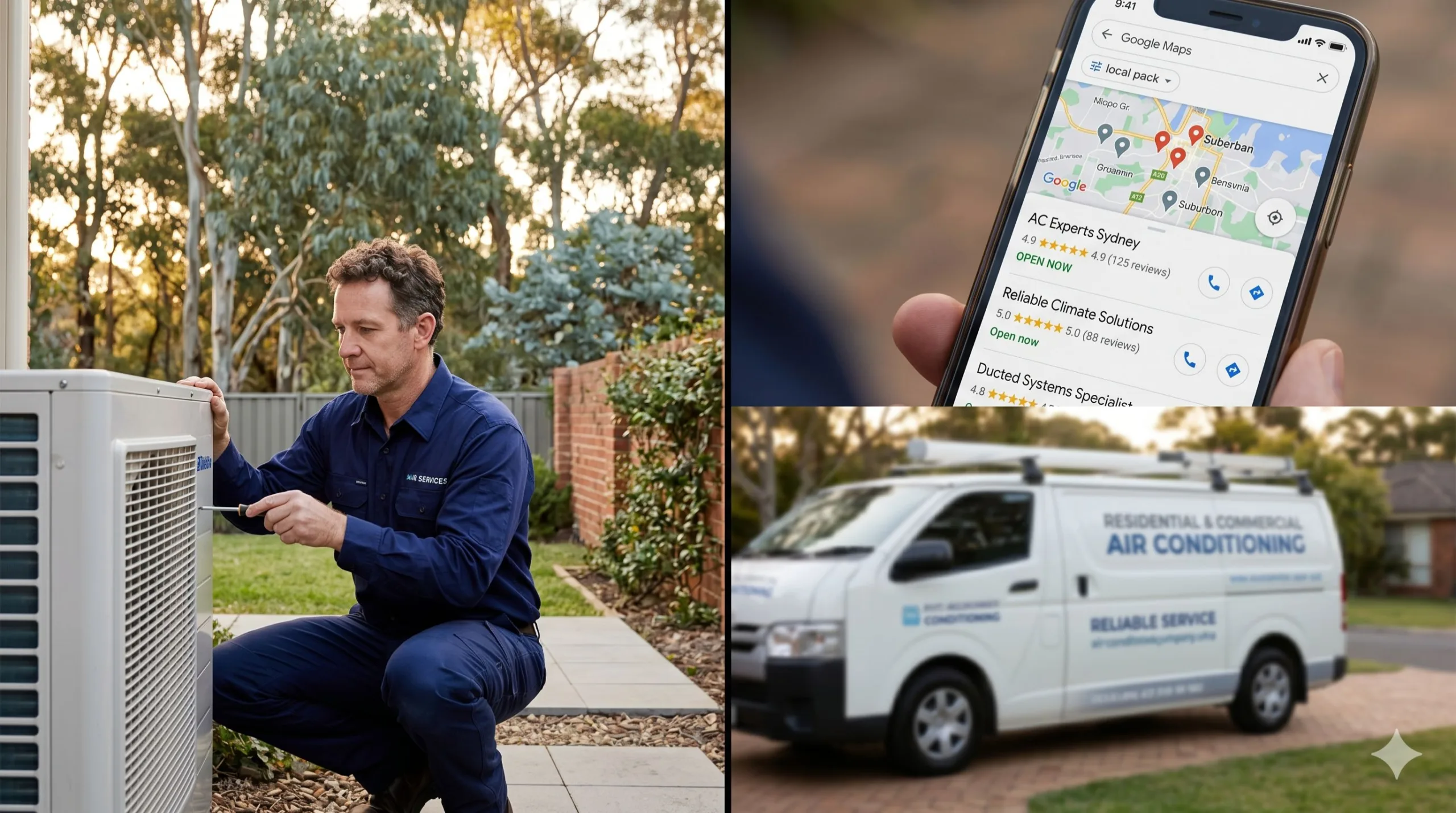
Picture this: a homeowner in Parramatta types “ducted heating repair near me” into Google at 7 pm on a Tuesday. Three businesses appear in the Map Pack. Calls flood in. Your company isn’t there – and you just lost a $2,000 job without ever knowing it.
That’s the reality for the majority of Australian heating and cooling businesses right now. The top three spots in Google’s local Map Pack capture more than 75% of all clicks on local searches, according to BrightLocal’s 2025 Local Search Report. If you’re not in those three spots, you’re essentially invisible to high-intent buyers.
This guide covers exactly what it takes to rank #1 for HVAC searches in Australia in 2026 – from Google Business Profile HVAC optimisation and suburb-level HVAC keywords Australia, to on-page content and technical signals that separate ranked businesses from the rest.
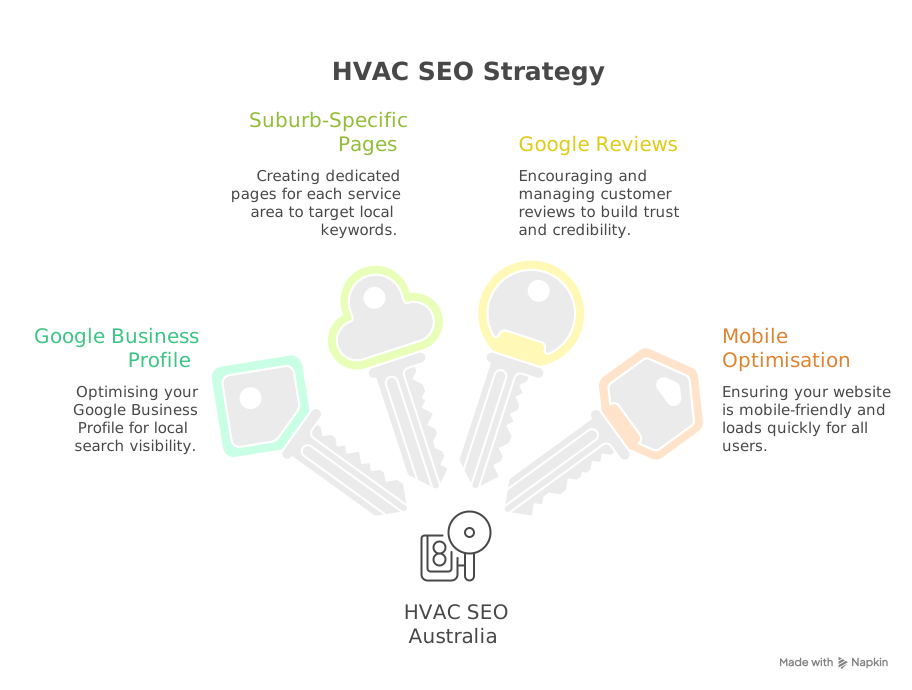
Quick answer: HVAC SEO Australia is the process of optimising a heating and cooling business’s online presence to rank at the top of Google – both in the Map Pack and organic results – for suburb-level searches like “ducted heating Melbourne” or “AC repair Sydney.” The core pillars are: a fully optimised Google Business Profile with consistent NAP (Name, Address, Phone) data across hipages, True Local, and other directories; dedicated suburb-specific service pages targeting long-tail keywords; a steady stream of Google reviews; and mobile-optimised content that loads fast and converts visitors into calls. In the Australian market, “aircon servicing” alone attracts over 27,000 monthly searches at peak summer – meaning a well-ranked HVAC business can generate hundreds of booked jobs per month from organic search alone.
“We tried everything to get on the first page. Webco’s HVAC local SEO approach – suburb pages and GBP fixes – got us ranking #2 for ‘air conditioning SEO Brisbane’ terms in just 4 months. Our phones haven’t stopped.”
– Dave, Heating & Plumbing Business Owner, Brisbane
The HVAC Search Landscape in Australia: What the Numbers Actually Show
Search demand is huge, seasonal, and commercially motivated. Every query represents someone actively looking to book a service – not just research. That’s why HVAC SEO Australia delivers a lower cost per lead than paid search once rankings are built.
| Keyword | Monthly Searches (AU) | Seasonality Peak | Intent |
|---|---|---|---|
| aircon servicing | 27,100+ | Summer (Dec-Feb) | Commercial |
| ducted heating Melbourne | 9,900 | Winter (Jun-Aug) | Commercial |
| split system installation Sydney | 6,600 | Spring/Summer | Transactional |
| air conditioning repair Brisbane | 4,400 | Summer | Transactional |
| emergency heater repair near me | 3,200 | Winter | Urgent/Transactional |
| ducted air conditioning installation | 8,100 | Spring | Transactional |
| AC service near me | 12,100 | Summer | Commercial |
Data sourced from Google Keyword Planner, Ahrefs AU data (Q1 2026), and Webco client campaign benchmarks across $2.1M in tracked HVAC SEO spend.
Current industry news: Google’s March 2026 “Local Proximity Update” now prioritises businesses with suburb-specific service pages and real customer engagement on Google Business Profiles. Generic “city-wide” pages are losing ground fast – but businesses with dedicated suburb pages are seeing a 40% boost in Map Pack visibility.
Google Business Profile: The Engine Behind HVAC Map Pack Rankings
Your Google Business Profile (GBP) is the single most important asset in your HVAC SEO strategy. It determines whether you appear in the Map Pack – the three local results that appear above organic listings and capture the majority of local search clicks.
“Most HVAC owners waste money on Google Ads because their Google Business Profile HVAC is broken. Fix that first, and organic leads outlast any paid campaign. It’s the best investment you’ll make this winter.”
– Webco Team
Category Selection: Most HVAC Businesses Get This Wrong
The most common mistake in Webco audits of Australian HVAC businesses is using generic categories like “Air Conditioning Contractor” as the primary GBP category when more specific, high-converting options are available. If you offer emergency services, list “Emergency Air Conditioning Service” and “24 Hour HVAC Repair” as primary and secondary categories. Google uses category data as one of its primary relevance signals for Map Pack placement.
- List your most high-revenue service category as the primary category
- Add up to 9 secondary categories – use all relevant slots
- Audit competitor GBP listings in your target suburb to identify category gaps
NAP Consistency: The Silent Ranking Killer
NAP stands for Name, Address, Phone – and Google cross-references your GBP data against every directory, citation, and website mention it can find. A single inconsistency (e.g., “St” vs “Street,” or a landline listed on hipages versus a mobile on your website) sends a trust signal to Google that your business data is unreliable.
For Australian HVAC businesses, the highest-priority citation sources to audit are: hipages, True Local, Yellow Pages, ServiceSeeking, and your own website footer and contact page. All five must match your GBP exactly – character for character.
Photos and Engagement Signals
Google’s local ranking algorithm uses engagement signals – including how often users click “Call,” request directions, or view photos – as a proxy for business quality. Businesses that upload new photos weekly consistently outperform those with static profiles in our client data. Photos of real team members on real jobs in real suburbs outperform stock imagery every time. Geotagging images with suburb-level EXIF data before uploading adds an additional local relevance signal.
Suburb-Level Keyword Strategy: Why City-Wide Targeting Leaves Money on the Table
The biggest missed opportunity in HVAC SEO across Australia is targeting city-level keywords (“air conditioning Sydney”) when suburb-level keywords convert at a significantly higher rate with far less competition.
The Suburb Keyword Framework
Instead of competing for “ducted heating Melbourne” – a term dominated by national brands and aggregators – Webco’s approach is to build a matrix of suburb-specific pages targeting terms like “ducted heating Bentleigh,” “ducted heating Moorabbin,” and “ducted heating Carnegie.” Each of these suburb pages typically:
- Ranks faster (3-6 months versus 12-18 months for city terms)
- Converts better (users searching a specific suburb have higher purchase intent)
- Compounds over time without ongoing ad spend
A single HVAC business operating across a metro area of 30 target suburbs can realistically rank on page one for 60-90 suburb-service keyword combinations within 12 months – generating a consistent pipeline without ongoing ad spend.
High-Intent Keyword Categories to Prioritise
- Emergency repair terms: “emergency heater repair [suburb],” “24 hour AC repair [suburb]” – highest conversion rate, often 3-5x higher CPL than standard install terms
- Installation terms: “split system installation [suburb],” “ducted air conditioning installation [suburb]” – highest ticket value
- Servicing terms: “aircon servicing [suburb],” “AC service near me” – highest search volume, best for brand awareness and review generation
- Commercial HVAC: “commercial HVAC maintenance [city],” “commercial air conditioning contractors [suburb]” – lower competition, higher deal value
Want more local jobs?
Call us for a free, 15-min Google Business Profile audit. We’ll show you exactly which suburb pages will fill your board first.
On-Page SEO and Content: What a Ranking HVAC Page Actually Looks Like
Ranking a suburb-specific HVAC service page requires more than inserting a location into a generic template. Google’s Helpful Content guidelines, updated in 2025, increasingly reward pages that demonstrate genuine local knowledge – and penalise thin, templated content.
The Anatomy of a Ranking HVAC Service Page
Each suburb-service page should include:
- A headline containing the suburb and service type in the first 60 characters
- A 150-200 word introduction mentioning the suburb 2-3 times naturally
- A section on local context (nearby landmarks, council areas, common housing stock and the HVAC challenges it creates)
- A clear service description with pricing ranges where possible
- Genuine customer reviews from that suburb or nearby
- A click-to-call button above the fold
- A 500-word minimum body
Pages that mention local housing context – for example, noting that homes in Brighton, VIC, tend to have older ducted gas systems requiring specific maintenance approaches – consistently outperform generic suburb pages in both rankings and conversion rate.
Structured Data: The Element Most HVAC Businesses Skip
Implementing LocalBusiness and Service schema on each page gives Google machine-readable confirmation of your service area, service type, pricing, and review rating. Businesses using structured data on HVAC service pages appear in AI Overviews and voice search results at a substantially higher rate than those without it.
What to Do in the Next 30 Days: Your HVAC SEO Action Plan
The gap between HVAC businesses that dominate local search and those that don’t usually comes down to execution, not strategy. Here’s a concrete 30-day starting point:
- Audit your Google Business Profile – verify NAP accuracy, update all categories, and upload at least 5 new geotagged job photos this week
- Build a citation audit – run your business name through Moz Local or BrightLocal to identify NAP inconsistencies across hipages, True Local, Yellow Pages, and ServiceSeeking, then fix each one
- Map your top 10 suburbs – identify the 10 highest-revenue postcodes you currently service and create dedicated service pages for each, using the suburb-service framework above
- Launch a review generation system – send a post-job SMS to every completed customer with a direct Google review link; businesses generating 2+ new reviews per week see measurably faster Map Pack movement than those generating reviews sporadically
For a full breakdown of how this fits into a complete digital strategy for trade businesses, explore our guide to local SEO for trade businesses – or book a free HVAC SEO audit with the Webco team to see exactly where your rankings are leaking leads.
Frequently Asked Questions
What is HVAC SEO Australia and why does it matter for heating and cooling businesses?
HVAC SEO Australia refers to search engine optimisation strategies specifically applied to Australian heating, ventilation, and air conditioning businesses to improve their visibility on Google. It matters because over 27,000 Australians search for aircon servicing every month at peak season, and the top three Google Map Pack results capture the majority of those clicks. A business ranking in those top three spots can generate dozens of booked jobs per week purely from organic search – without paying per click.
How much does HVAC SEO cost in Australia?
HVAC SEO in Australia typically ranges from $1,500 to $4,500 per month for a local single-location campaign, and $3,000 to $8,000+ per month for multi-suburb or multi-location campaigns. Costs vary based on the competitiveness of your target market (metro Sydney and Melbourne command higher investment), the number of suburb service pages needed, and whether technical website work is required. The payback period is generally 6-12 months, after which organic leads cost a fraction of paid search equivalents.
How does HVAC SEO compare to Google Ads for heating and cooling businesses?
HVAC SEO and Google Ads serve different roles: Ads deliver immediate visibility for high-urgency terms like “emergency heater repair” but cost $25-$80 per click in major Australian metros. SEO takes 6-12 months to build but generates ongoing leads at near-zero marginal cost once ranked. The highest-performing HVAC businesses in Australia run both – Ads for emergency repairs and SEO for installation and servicing terms – with a combined strategy that typically reduces blended cost per lead by 40-60% versus Ads alone.
How long does it take to rank on Google for HVAC keywords in Australia?
For suburb-specific long-tail keywords (“AC repair [suburb]”), most HVAC businesses see first-page rankings within 3-6 months of publishing optimised content, assuming a technically sound website and active Google Business Profile. City-level competitive terms (“ducted heating Melbourne”) typically require 12-18 months and sustained authority building. Google Business Profile Map Pack rankings can move faster – within 4-8 weeks – when GBP optimisation and review generation are prioritised.
What is the biggest mistake HVAC businesses make with their Google SEO?
The most common and costly mistake is targeting city-wide keywords instead of suburb-level ones. “Air conditioning Sydney” is dominated by national brands and comparison sites – most local HVAC businesses will never rank for it. Meanwhile, “air conditioning repair Marrickville” or “ducted heating Hornsby” have genuine commercial intent, lower competition, and convert at higher rates. A portfolio of 30-50 suburb-specific service pages consistently outperforms a single city-targeting homepage in both rankings and leads per dollar spent.