
Aussie Tradies: Are Your Heating & Cooling Leads Getting More Expensive?

Here’s a Free Guide: 9 Ways to Reduce Your Cost Per Lead

Use It Yourself or Hand It to Your Marketing Team

Heating and cooling owners, sparkies and plumbers: if you run a tradie business in Australia, you’ve probably felt it creeping up on you.


Your ad spend keeps going up, but your calendar isn’t filling with better jobs.

 
Marketing might not be your expertise, but when the calendar’s not full and the jobs dry up, you don’t have a choice.
 
You’re left with two options: blindly trust your marketing agency, or learn the exact leverage points to push back so you can ask tough questions and demand real results.
This guide is for the second option.

What’s Your Biggest Problem Right Now?

🚫 You’re getting fewer leads for the same spend.
🚫 Lead volume looks fine, but 70% are tire-kickers or wrong-suburb calls.
🚫 You’ve increased your ad budget, but your booked job count hasn’t moved up.
 
If any of these sound painfully familiar, here’s what you need to know:
🚨 Your cost per lead is climbing.
💰 It’s rarely the budget – it’s where the budget is going.
✅ There’s a leak in the system, and it’s fixable.
 
Before you throw another dollar at Meta (Facebook) or Google, you need to find out where the money is walking out the door.
 
We’re about to show you exactly where to look and what to fix.
 
“Do I Just Need to Spend More?”
If you’ve asked your marketing team this, here’s the truth: the money is usually already there. It’s just leaking out in a few predictable places.

The Five Biggest Leaks Burning Australian HVAC Ad Budgets

1. Wasted search spend:
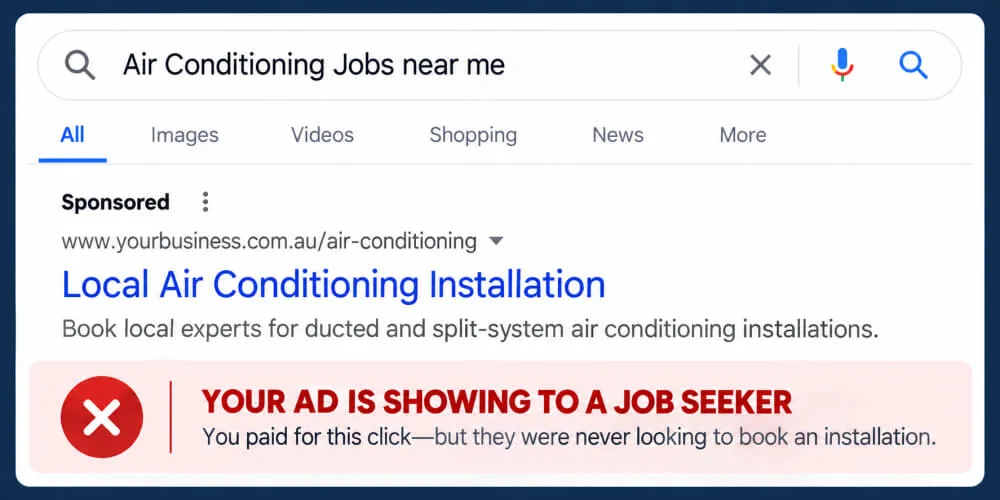
Paying for clicks from searches that were never going to become jobs. “Air conditioning course.” “Air conditioning jobs.” “Portable air conditioner.” None of these searchers was ever going to book an installation.
2. Out-of-area suburbs
Generating “cheap” $20 leads from areas your installers won’t service.  
3. Landing page disconnect
Sending a customer searching for an emergency ducted repair to a generic homepage that takes six seconds to load with no next steps.
4. The “free quote” trap
Offering exactly what every competitor on Google is offering. It gives homeowners no urgent reason to choose you today.
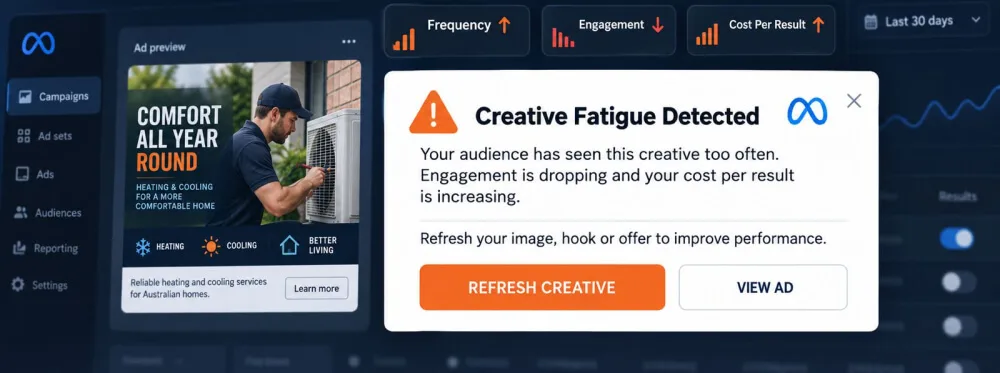
5. Creative fatigue:
Running the same ad visual for two months until performance drops and your costs start climbing.
None of this is complicated to fix. Most businesses simply haven’t been shown where to look.

This Isn’t Theory. It’s Our Actual Playbook.

This is the process we use to help our clients cut their cost per lead by 20 – 40%.

Over 10 years of running campaigns for Australian service businesses, we’ve tested strategies, made mistakes, pulled apart the numbers and learned what actually brings the cost per lead down.
 
Those lessons became our internal framework. Every time we review a campaign, we ask three questions:
  1. What can we tighten to bring the cost per lead down?
  2. Where is money being spent without producing results?
  3. How can we get better results from the budget already in place?
 
For years, this framework stayed inside our business. Now, we’re handing it over.

📘9 Ways to Reduce Your Cost Per Lead covers the exact checks we use across your offer, targeting, ads, landing pages, campaign setup and follow-up – all built on 10 years of running real campaigns with real budgets.

The Results Our Clients Are Seeing From the Campaigns We Run

Before You Spend More,
❌ Don’t ask, “How do I get more leads?”
✅ Ask this instead: “What’s my cost per qualified lead – and my cost per booked job?”
 
A $20 lead that never books anything isn’t cheap. A $50 – $80 lead that turns into a $15K installation could be one of the best marketing investments you make.
 
Most owners only track one number. The businesses getting real results track three:

#MetricFormulaWhy It Matters
1Cost Per Lead (CPL)Ad Spend ÷ Total LeadsGives you the surface-level volume.
2Cost Per Qualified LeadAd Spend ÷ Potential CustomersFilters out tire-kickers and wrong suburbs.
3Cost Per Booked JobAd spend ÷ Jobs Actually WonThe only number that truly pays your bills.

Track all three, and it quickly becomes obvious where the real problem is.

The Bit Most Guides Skip

Anyone can tell you to “improve targeting” or “fix your landing page.” What actually moves the needle is how – the specific checks, in the specific order, that stop the leak before it ever becomes a lost enquiry.
 
That’s exactly what’s inside 9 Ways to Reduce Your Cost Per Lead – built specifically for Australian heating and cooling businesses running, or planning to run, Google and Meta ads.
 
No theory. Just a straight walkthrough of your search terms, targeting, landing pages, offer and creative — plus a 9-point self-audit you can run on your own campaigns in 30 minutes, before you spend another dollar.

The Bottom Line

Rising ad costs don’t mean digital marketing’s stopped working for heating and cooling businesses. It means the businesses winning right now are tighter with where the budget goes — and the ones falling behind are still chasing volume over value.
 
You don’t need a bigger budget. You need to know where to look.
Grab the free guide, run the 9-point audit against your own campaigns this week, and count the “no” answers. Every one is money walking out the door right now – and now you’ll know exactly where to go get it back.

FAQs

What's a good cost per lead for a heating and cooling business in Australia?

It depends on the channel and job type — a Google Ads search lead typically runs $50–$150, while Meta leads can be cheaper ($20–$60) but lower intent. The number that matters more than cost per lead is cost per booked job: a $20 lead that never converts is more expensive than an $80 lead that books a $15K installation.

Rising cost per lead is usually a symptom of budget leaking into low-intent search terms, out-of-area suburbs, or ad creative that’s been running unchanged for months. It’s rarely a bidding problem — it’s almost always a targeting, offer, or fatigue problem.

Not before auditing where your current budget is going. In most campaigns we review, the money to fund more (and better) leads is already in the budget — it’s being spent on searches, suburbs, or creative that were never going to convert.

Cost per lead only measures what you paid to generate an enquiry. Cost per booked job measures what you paid to actually land a paying customer. A campaign can look cheap on cost per lead and still be losing money once you factor in how few of those leads turn into real jobs.

Most of the fixes — tightening search terms, excluding out-of-area suburbs, refreshing stale ad creative — can be implemented within a week and start showing impact within the next billing cycle. Businesses that run a full audit against all nine leak points typically see cost per lead drop 20–40%.

Work with us.

Fill out the form below to speak with someone from our team.

By clicking the button below, you consent to Webco Group and its partners using automated technology, including pre-recorded messages, phone calls, text messages, and emails, to contact you at the phone number and email address provided. This applies even if your number is on a Do Not Call list. Your consent is not required to make a purchase. Privacy Policy.