

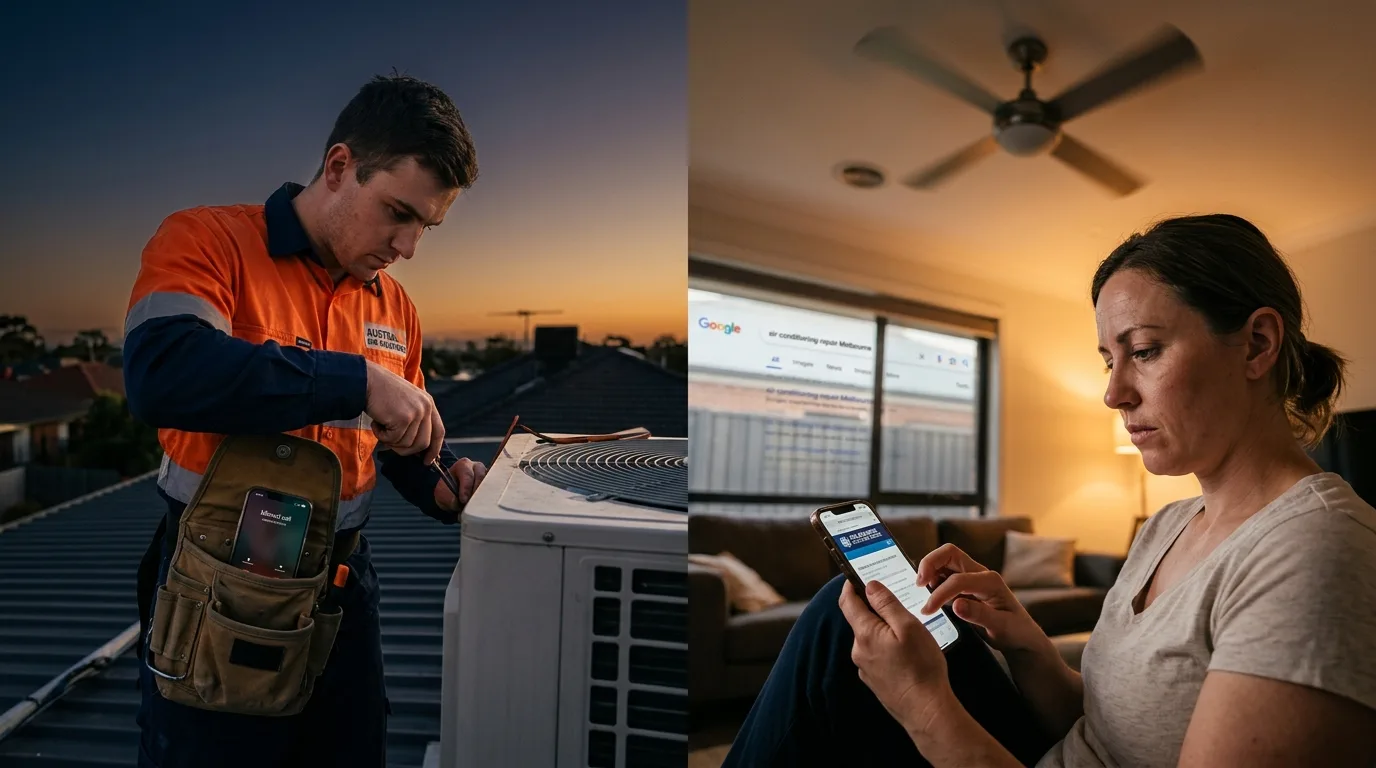
Air conditioning and heating businesses lose booked jobs every day because urgent customers dial the next contractor the moment a call rings out. Missed call text-back is the fix: an automation that fires an SMS within about 60 seconds of a dropped call, holding the lead until your office or on-call technician can reply. For Australian trade businesses, it recovers the after-hours demand you already paid Google Ads to create, and turns a dead ring into a booked job.
The leak is invisible. A missed call leaves no line in your accounting software and no flag on a dashboard, so the problem survives for years inside otherwise well-run businesses. This guide breaks down the numbers behind the leak, the real cost in cost-per-booked-job terms, and the exact six-step setup Webco uses to capture those calls before a competitor answers first.
78%
of leads go to the first business that responds (LeadTruffle)
3%
of callers actually stop to leave a voicemail
~40%
of emergency calls arrive after 5:00pm
60 sec
to text a missed caller back and hold the job
1. The First-Responder Rule Decides Who Wins
In home services, the business that responds first usually wins the job. LeadTruffle puts the first responder’s share of leads at around 78%. A customer with no cooling in a heatwave is not loyal to your five-star rating or your ARCtick-licensed technicians; they are loyal to whoever picks up first. If your phone rings out while a tech is on a rooftop with both hands in a condenser, a competitor two minutes faster books the job, and you never see it happen.
- Benchmark: LeadTruffle reports roughly 78% of leads go to the first responder.
- Reality: review count and years in trade count for nothing if a rival answers first.
- Fix: an instant text-back keeps you in the race even when nobody can pick up live.
2. Why Voicemail Is a Dead End
Owners assume a missed call is safe because the customer can leave a message. They do not. Only about 3% of people who hit a disconnected line or voicemail will actually record one. During a heatwave or cold snap, when the Bureau of Meteorology is issuing warnings and every aircon company in the suburb is slammed, that number gets worse, not better. Traditional message-taking is close to useless in exactly the moments you most need to capture demand.
- Benchmark: only about 3% of callers leave a voicemail.
- Peak demand makes it worse: stressed customers keep dialling, not talking.
- Fix: a two-way SMS is faster and easier for the customer than a voicemail.
3. After Hours Is Prime Time, Not Downtime
Close to 40% of emergency air conditioning and heating calls arrive after 5:00pm, once standard offices have shut. Breakdowns do not respect business hours; systems fail when they work hardest, which is late afternoon and evening in summer, and early morning in winter. If your answer to after-hours demand is an unattended phone, you are effectively donating your most profitable emergency overflow to competitors who automated their response while you were closed.
- Benchmark: close to 40% of emergency calls land after 5:00pm.
- Timing: summer evenings and winter mornings are peak failure windows.
- Fix: an after-hours message path prioritises genuine no-cooling and no-heating jobs.
4. The Real Cost: Wasted Ad Spend and a Monthly Leak
For a Webco client, the sharpest way to feel this is cost-per-booked-job. You already pay to make the phone ring, so every unanswered ring means you paid for the lead and then gave the job away. Take a business spending $2,000 a month on Google Ads at a $40 cost per lead. That is 50 leads. If 15 ring out after hours, at a 30% close rate and a $6,000 average ducted replacement, roughly $27,000 in booked-job value walks to a competitor, plus the ad spend you burned to generate it.
Input
Value
Monthly Google Ads spend
$2,000
Cost per lead
$40
Leads generated
50
After-hours calls that ring out
15
Close rate
30%
Average ducted replacement
$6,000
Booked-job value lost per month
~$27,000
US contractor data from Deantek estimates around US$3,800 a month in uncaptured jobs. Treat that as a directional US benchmark, not a verified Australian figure. The point holds in any currency, because the money leaks quietly, one unanswered ring at a time.
5. The Fix: A Text-Back That Replies in 60 Seconds
Missed call text-back is a simple automation with an outsized return. The moment a call is missed, your CRM fires an SMS to the caller within about 60 seconds. It confirms you are a real, responsive business, keeps the customer on their phone instead of scrolling to the next result, and opens a two-way conversation your office staff or on-call technician can pick up the moment they are free. The goal is not to replace human contact; it is to buy time.
Sorry we missed your call at Webco Air. Is this an emergency, or can we book a technician for you? Reply here and we will sort it out.
- Confirms: the customer sees a real business replied within seconds.
- Holds: they describe the fault and effectively keep their place in your queue.
- Runs on: GoHighLevel or a similar platform connected to your business number.
6. How to Set It Up for Your Business
Setting up missed call text-back takes an afternoon, not a rebuild. Connect your business number to a CRM that supports it, write separate business-hours and after-hours messages, route replies to a shared inbox, add an emergency keyword path, and track every recovered lead against your ad spend. Done properly, your existing budget works harder, because you finally capture the demand you already paid to create. Here is the sequence Webco follows.
- Connect: link your business number to a CRM like GoHighLevel so every missed call triggers an event.
- Write two variants: a business-hours reply and an after-hours reply with an EMERGENCY keyword.
- Route replies: send them to a shared inbox your office staff and on-call technician both see.
- Prioritise emergencies: add a keyword path so no-cooling and no-heating jobs jump the queue.
- Measure: track recovered leads as a line item against ad spend to prove the new cost-per-booked-job.
Frequently Asked Questions
What is missed call text-back for HVAC businesses?
Missed call text-back is an automation that sends an instant SMS to any caller you miss, usually within 60 seconds. For an air conditioning or heating business, it captures urgent breakdown calls that would otherwise ring out and go to a competitor. The text keeps the customer engaged and lets your office or on-call technician reply and book the job when they are free, instead of losing the lead to voicemail.
How much revenue do HVAC businesses lose to missed calls?
US contractor benchmarks from Deantek estimate around US$3,800 a month in uncaptured service and replacement jobs, which is a directional figure rather than an exact Australian number. The real cost depends on your call volume, close rate, and average job value. A handful of missed after-hours calls a week, at typical ducted replacement values, can add up to tens of thousands of dollars in lost booked-job value over a year.
Why do customers not just leave a voicemail?
Only about 3% of people who reach a disconnected line or voicemail actually leave a message. In an emergency, such as no cooling during a heatwave, customers want an immediate answer, so roughly 78% simply dial the next contractor on Google and never call back. Voicemail is close to useless during peak demand, which is exactly when you receive the most calls.
When do most emergency HVAC calls happen?
Close to 40% of emergency HVAC calls arrive after 5:00pm, once standard offices have closed. Systems fail when they work hardest, which is late afternoon and evening in summer and early morning in winter. This after-hours window is where most owners lose profitable overflow, because an unattended phone sends that work straight to competitors who automated their response.
Which tool sends the automated text-back?
Most Australian air conditioning and heating businesses run missed call text-back through a CRM like GoHighLevel, connected to their business phone number. The system detects a missed call and fires an SMS automatically. Webco configures the message logic, the emergency keyword path, and the reply routing so genuine jobs are prioritised and every recovered lead is tracked against your ad spend.
Stop Donating After-Hours Jobs to Competitors
Webco builds missed call text-back into a broader air conditioning and heating lead generation system focused on booked jobs, not vanity metrics. We wire the message logic, the emergency keyword path, and the reply routing into your booking process, then track every recovered lead against your ad spend.