

HVAC (Air Conditioning & Heating) Website Design: 9 Elements That Turn Visitors into Booked Jobs
Updated 07 July 2026 · By Webco Growth Team · 8 min read
Your website isn’t losing leads because of how it looks. It’s losing them because it was built for browsing, not for a 42°C emergency.
When a Melbourne homeowner’s split system dies during a heatwave, they don’t browse air conditioning websites — they scan them, phone in hand, and make a decision in under a minute. The average Australian HVAC website converts fewer than 3% of those visitors into an enquiry. The best convert 7–10%. On 500 monthly visitors, that gap is the difference between 15 leads and 50 — same traffic, same ad spend, triple the booked jobs.
Most advice on HVAC website design comes from American agencies writing about furnaces in Texas. Australian buying behaviour is different: ARCtick licensing questions, evaporative-vs-refrigerated decisions, heatwave-driven demand spikes, and a mobile share of trades searches above 70%. This guide covers the nine elements that actually move bookings for Australian air conditioning and heating businesses — each one gradeable against your own site today.
Quick answer
High-converting HVAC website design in Australia comes down to nine elements: a sticky click-to-call button, sub-2.5-second mobile load speed, an Australian trust stack (ARCtick licence, reviews, real team photos), one page per service, suburb-level service area pages, instant online booking, transparent from-pricing, seasonal conversion banners, and schema markup for AI search. Sites with all nine convert 7–10% of visitors into enquiries; typical air conditioning sites convert under 3%.
How the 9 elements stack up
| # | Element | Conversion impact | Effort to fix |
|---|---|---|---|
| 1 | Sticky click-to-call | Highest single impact on mobile | Low |
| 2 | Sub-2.5s mobile load | Compounds everything below | Medium |
| 3 | Australian trust stack | 20–30% enquiry lift | Low–medium |
| 4 | One page per service | Doubles paid-traffic conversion | Medium |
| 5 | Suburb service pages | Organic lead flow (Map Pack + local) | Medium–high |
| 6 | Instant booking + after-hours capture | Recovers 30–40% of lost leads | Medium |
| 7 | Transparent from-pricing | Filters tyre-kickers, lifts lead quality | Low |
| 8 | Seasonal conversion banners | Captures heatwave/cold-snap surges | Low |
| 9 | Schema + AI-search readiness | Future lead flow (AI Overviews, ChatGPT) | Medium |
Element 1: A sticky click-to-call button that never leaves the screen
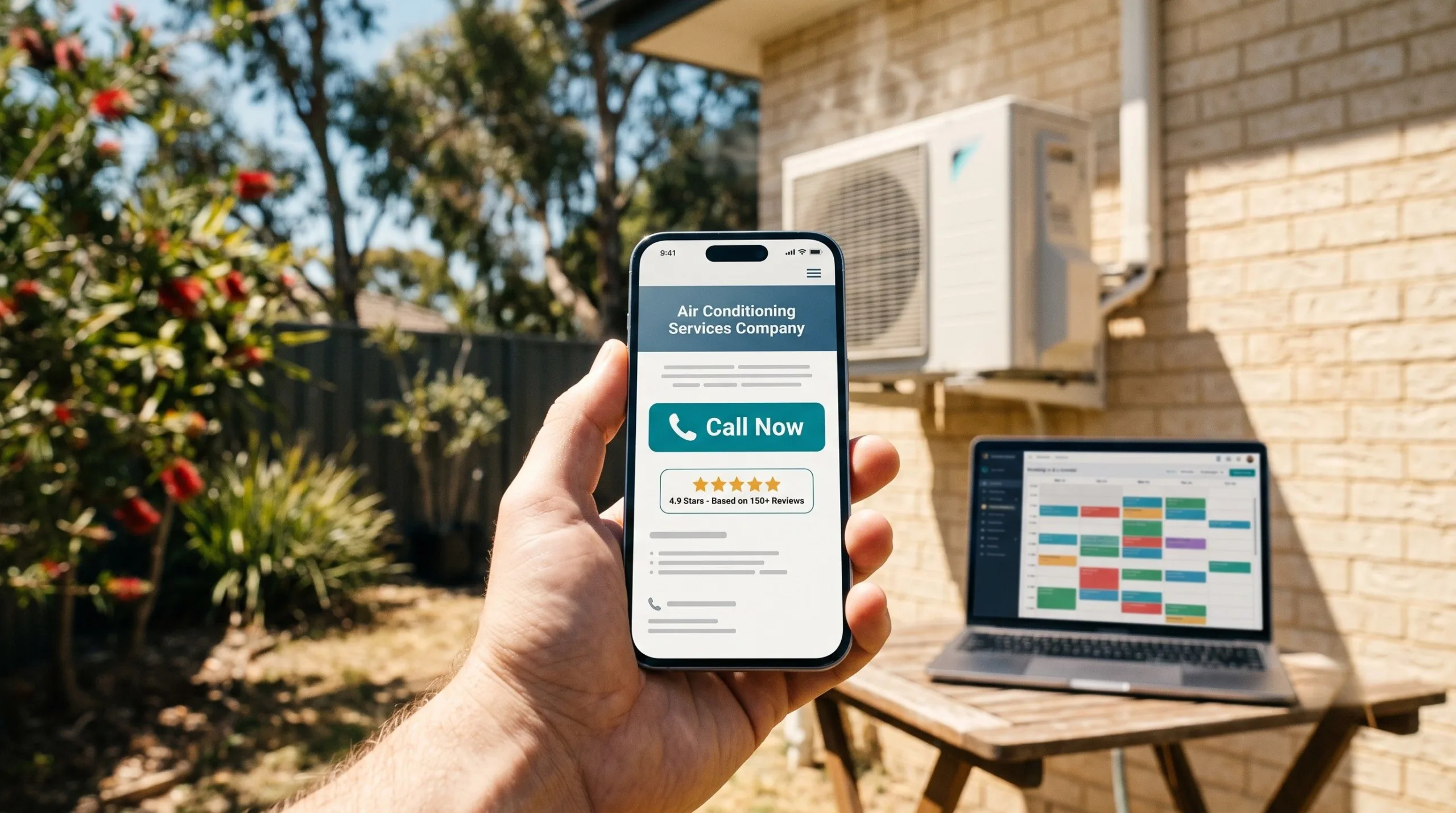
Roughly 60–70% of air conditioning and heating enquiries arrive by phone, not form — and on mobile, a tap-to-call button that stays pinned while the visitor scrolls is the single highest-impact conversion element you can add. It needs three things: a contrasting colour, thumb-reach placement (bottom of screen, not top corner), and your real local number rather than a generic “Contact Us” link. If your phone number currently lives in the footer, you are donating every emergency caller to whichever competitor put theirs above the fold.
Element 2: Mobile load speed under 2.5 seconds
More than 70% of Australian trades searches happen on a phone, and a visitor on 4G in a hot house abandons any page that takes longer than about three seconds. Google’s Core Web Vitals — Largest Contentful Paint under 2.5s in particular — are also a ranking input, so speed pays twice. The usual culprits on air conditioning sites are uncompressed hero images, bloated page-builder themes and missing caching. Run your site through PageSpeed Insights today; if mobile scores under 70, every other element on this list is working with a handicap.
Element 3: The Australian trust stack ARCtick, reviews, real faces
American sites lean on BBB badges and “family owned since 1968.” The Australian equivalent converts harder because it’s regulated: display your ARC refrigerant handling licence number (homeowners increasingly check it), AIRAH membership if you hold it, and your actual Google review score in a live widget — not a static screenshot. Then replace stock photos with your own techs, utes and completed installs. Human faces of the people entering the customer’s home measurably reduce perceived risk, and no US template can fake a photo of your crew on a Colorbond roof in Craigieburn.
Element 4: One page per service not one homepage for everything
Split system installation, ducted reverse-cycle, evaporative cooling, gas ducted heating, servicing and repairs are five different buying decisions with different price points and different search terms. Each needs its own page with a matching headline, its own proof and its own booking path. This matters double if you run ads: a dedicated service landing page converts paid traffic at 7–10%, versus 3–4% for a homepage. It’s the most expensive design mistake in the industry, and the cheapest to fix.
Element 5: Suburb-level service area pages that feed the Map Pack
“Air conditioning installation Frankston” and “ducted heating Werribee” are searched by people ready to buy from someone nearby. One well-built page per service area — with genuinely local content: suburbs served, local install photos, response times, area-specific reviews — is the foundation of organic lead flow that doesn’t cost per click. The discipline that separates this from spam: one page per intent cluster, not one page per keyword, and every page must contain something a competitor couldn’t copy-paste for their own suburb.
Element 6: Instant booking plus after-hours capture
An enquiry form that promises “we’ll get back to you within 24 hours” loses the 9pm heatwave searcher to the first competitor who answers. Two fixes: an embedded live booking calendar (pick a time slot, done) for non-urgent work, and after-hours capture — AI call answering or instant SMS-back — for the calls that land when nobody’s in the office. Australian air conditioning businesses miss an estimated 30–40% of enquiries outside business hours during peak season; capturing even half of those is often worth more than any traffic increase.
Element 7: Transparent from-pricing that filters, not frightens
Most HVAC sites hide pricing entirely, which forces every visitor — serious or not — to call for the one thing they wanted to know. Publishing honest “from” pricing (“split system installation from $1,450 including standard back-to-back install”) does two jobs: it pre-qualifies leads so your team stops quoting tyre-kickers, and it wins the trust of comparison shoppers who assume hidden pricing means inflated pricing. Pair it with finance options (interest-free terms are now a deciding factor on $8,000+ ducted jobs) and you convert the considered buyer as well as the emergency one.
Element 8: Seasonal conversion elements tied to Australian weather
Demand for cooling triples within days of a Bureau of Meteorology extreme-heat forecast; heating enquiries surge with the first May cold snap. Your website should change with it: a heatwave banner (“Same-week split system installs — 3 slots left this week”), a winter switch to gas heating service messaging, and off-season maintenance offers to smooth the shoulder months. Static websites treat February and May identically; converting websites don’t.
Element 9: Schema markup and AI-search readiness
A growing share of “best air conditioning installer near me” answers now come from Google AI Overviews, ChatGPT and Perplexity — and those engines cite websites with clean structured data, direct-answer FAQ content and consistent entity signals. Minimum standard for 2026: LocalBusiness schema with your service areas and ARC licence, FAQPage schema on service pages, review markup connected to your Google Business Profile, and question-format content that answers what homeowners actually ask (“how much does ducted air conditioning cost in Melbourne?”) in extractable 60–90 word blocks. Your website’s next decade of leads depends on being citable, not just rankable.
What to do this week: fix these first before spending more on ads
Run the 9-element audit. Score your site 0–9 against this list. Under 6 means your marketing spend is leaking before it converts.
Fix the free wins first. Sticky call button, from-pricing block, ARC licence display — all achievable in a day, no rebuild required.
Test your mobile speed. PageSpeed Insights, mobile tab. Under 70 means speed work before design work.
Map your service and suburb page gaps. List every service × area combination you profit from; every one without a page is organic demand you’re conceding.
Your website is one part of the growth system. It converts the demand created by SEO, Google Ads, and your Google Business Profile into real enquiries and booked jobs.
To see how the full system fits together for Australian air conditioning and heating businesses, book a free website audit. We’ll score your site against all nine elements, then prioritise the fixes based on impact, cost, and speed to implement.
Frequently asked questions
What makes a good HVAC website design in Australia?
Good HVAC website design in Australia combines nine elements: sticky click-to-call, sub-2.5-second mobile load, an Australian trust stack (ARCtick licence number, live Google reviews, real team photos), dedicated pages per service, suburb-level service area pages, instant booking with after-hours capture, transparent from-pricing, seasonal conversion banners, and schema markup for AI search. Sites with all nine typically convert 7–10% of visitors into enquiries versus under 3% for template sites.
How much does an HVAC website cost in Australia?
A professionally built air conditioning or heating business website in Australia typically costs $3,000–$8,000 for a conversion-focused small business build, and $8,000–$20,000+ for multi-location businesses needing suburb page architecture, booking integrations and CRM connection. Template DIY builds cost under $1,000 but usually convert below 3%, which makes them the most expensive option once you count lost leads against paid traffic.
What conversion rate should an air conditioning website achieve?
An air conditioning website should convert 5–10% of visitors into enquiries (calls plus forms), with dedicated service landing pages reaching 7–10% and general sites averaging 3–5%. Below 2% indicates structural problems — usually a missing click-to-call button, slow mobile load, or traffic landing on a generic homepage instead of matching service pages. Measure calls with dynamic call tracking, not forms alone, since 60–70% of HVAC conversions happen by phone.
Do suburb service area pages still work for SEO in 2026?
Yes — suburb service area pages remain one of the strongest organic lead sources for Australian HVAC businesses in 2026, provided each page targets an intent cluster (one page per service-area combination) and contains genuinely local content: local install photos, area-specific reviews, response times and suburbs served. Thin, duplicated location pages no longer rank and can hurt the whole site. Quality-per-page beats quantity-of-pages.
What's the biggest HVAC website design mistake?
Sending all traffic to the homepage. A homepage built to introduce the business converts at 3–4%, while a dedicated service page with a matching headline, proof and booking path converts at 7–10% — so the mistake silently halves lead volume across every channel feeding the site. The second biggest is burying the phone number: with 60–70% of enquiries arriving by call, any design where the number isn’t visible without scrolling loses emergency buyers entirely.