

Picture a typical week for a two-van heating and cooling operation. Fifteen inbound enquiries come in. The owner takes six calls personally, the admin handles four, and five ring out or land in voicemail during busy periods. Of the ten that are contacted, eight get a quote. Of those eight, three accept immediately. Two more accept after a follow-up call, if someone remembers to make it. The other three go cold and are never chased again.
That business just converted 5 out of 15 leads. A 33% rate. And because the missed calls, the unsent follow-ups, and the abandoned quotes leave no visible record, the owner assumes the market is just slow.
The market isn’t slow. The pipeline is leaking.
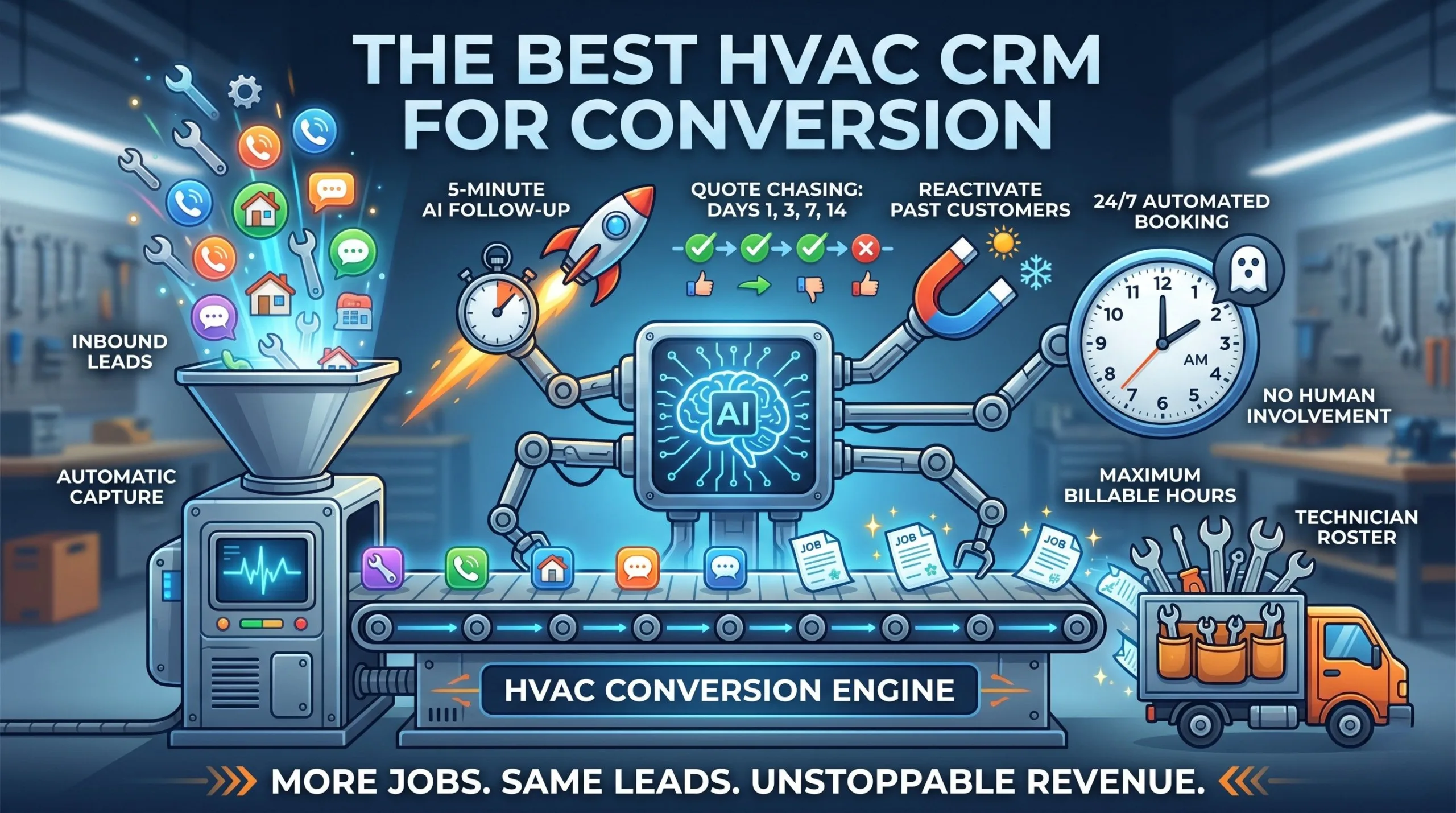
Quick answer: The best CRM for an HVAC business is one built around conversion, not data storage. It captures every inbound lead automatically, triggers an AI follow-up within 5 minutes, chases unaccepted quotes on days 1, 3, 7 and 14, reactivates past customers before seasonal peaks, and books after-hours calls without human involvement. The result is more jobs filled from the same lead volume, which means more billable hours for every technician on your roster.
Why Most HVAC Businesses Are Running at 60% of Their Potential
Webco Audit Data (100+ HVAC businesses):
- Average quote follow-up rate: under 20%
- Average missed-call rate during business hours: 18 to 34%
- Past customers never reactivated before a seasonal peak: 85%
None of these gaps show up on any report. They exist only as revenue your competitors captured while your pipeline sat idle.
A CRM built for HVAC businesses fixes all three leaks simultaneously, not by adding more work for your admin team, but by automating the actions that currently don’t happen at all.
What 'CRM for HVAC Business' Actually Means in 2026
The acronym stands for Customer Relationship Management. But the term covers a spectrum so wide it’s nearly meaningless without qualification.
At one end: a spreadsheet with customer names and phone numbers. Technically a CRM. Practically useless.
At the other end: an AI-powered system that captures every lead the moment it arrives from every source, your website, Google Ads, social media, phone calls, logs it without any manual input, triggers an immediate personalised response, tracks every interaction through a live pipeline, automates follow-up sequences based on real behaviour, and produces revenue attribution reporting that shows which channels are generating booked jobs and which are consuming budget with nothing to show for it.
For an HVAC business, only the second kind moves the needle. And the gap between the two is measured in booked jobs, technician utilisation rates, and annual revenue.
The 5 CRM Functions That Fill a Heating and Cooling Schedule
1. Instant Lead Capture From Every Channel
Every inbound enquiry, a call, a form submission, a Facebook message, a Google Business Profile click, creates a new lead record automatically. No manual data entry. No leads missed because the admin was on another call. No enquiries sitting in an email inbox for 18 hours before anyone notices.
The moment a lead is captured, it is visible in a live pipeline dashboard. The business owner and relevant technician can see it within seconds. And the automated response sequence is already running.
This matters because HVAC leads have an exceptionally short window of maximum intent. A homeowner whose ducted heater just failed on a cold winter morning is ready to book right now. The same homeowner who doesn’t hear back for three hours has already called two competitors and booked the second one who answered.
The speed-to-lead gap: The CRM closes the window between “enquiry received” and “lead contacted” from hours to seconds. In HVAC, that gap is the difference between winning the job and funding your competitor’s next callout.
2. AI-Powered Follow-Up That Never Forgets
Most HVAC businesses contact new leads in hours, or not at all if they come in after 5 pm. An HVAC CRM with AI automation deploys an immediate response the moment a lead is captured: an SMS acknowledgment, an AI voice call to qualify the job type, or both, depending on the time of day and the urgency signal from the lead source.
For leads that don’t convert on the first contact, automated follow-up sequences run in the background: day 1, day 3, day 7, day 14. Each message is contextualised to the lead’s situation, a different message for an emergency repair enquiry than for a ducted system installation quote, so it reads as relevant and personal rather than a generic broadcast.
Harvard Business Review + MIT Research:
Leads contacted within 5 minutes convert 21 times more often than leads contacted after 30 minutes.
Leads that receive five structured follow-up touchpoints convert at materially higher rates than leads that receive one or two.
3. Quote Follow-Up Automation That Recovers Lost Revenue
Sending a quote and waiting is one of the most expensive habits in the trades. A homeowner getting three ducted heating quotes is comparing your price, your reviews, and your responsiveness over a period of days. The competitor whose CRM automatically follows up with a value-add message on day three wins a disproportionate share of those jobs.
When a quote is sent, a follow-up workflow is triggered automatically. If the quote is accepted, the workflow stops and the job moves to scheduling. If it isn’t, the sequence continues at set intervals with messages calibrated to the quote value and job type, until the prospect books, declines explicitly, or the sequence completes.
Revenue recovery example:
40 quotes per month at an average job value of $4,500.
Recovering just 2 additional jobs per month from automated follow-up = $108,000 in additional annual revenue.
Industry data: 70% of sales happen after the 5th follow-up. Most businesses follow up fewer than twice.
4. Seasonal Reactivation That Fills Shoulder-Month Schedules
The most overlooked revenue source in any HVAC business is the customer database that already exists. Customers who have had work done are warm, trusting, and statistically likely to need heating and cooling services again, but 85% of them are never contacted between jobs.
A CRM with seasonal reactivation automation changes this completely:
- Before winter: automated SMS and email campaigns go to every customer who has had heating work done, offering a pre-season service or system health check
- Before summer: the same campaign runs for cooling customers
- At the 4 to 6 year mark: replacement-intent campaigns are triggered for customers whose installed systems are approaching the end of useful life
These are not cold leads paying $180+ in Google Ads cost-per-click to acquire. They are warm customers who already trust your business, have your number, and are statistically due for another job. Shoulder months, October, March, the periods between peak heating and cooling demand, fill up with maintenance and service work from reactivated past customers rather than expensive new lead acquisition.
5. Revenue Attribution That Tells You What's Actually Working
Most HVAC businesses make marketing decisions based on guesswork. An integrated CRM with revenue attribution reporting removes the guesswork entirely. Every lead is tracked from its original source, which Google Ads keyword, which organic suburb page, which Facebook ad, through every interaction to the final closed job.
What attribution data makes obvious:
- If Google Ads generates leads at $65 per booked job and Facebook at $210 per booked job, the budget decision is clear
- If after-hours AI call answering converts at 68% and business-hours calls at 31%, the systems decision is clear
Without this data, you are optimising an HVAC business in the dark. With it, every dollar of marketing spend compounds more efficiently than the last.
How These Five Functions Compound Into Technician Utilisation
Growing an HVAC business without growing headcount is a technician efficiency problem as much as a marketing problem.
Every job that books from a previously cold quote follow-up fills a technician hour that would have been idle. Every shoulder-month reactivation campaign adds a maintenance visit to a schedule that would have sat partially empty. Every after-hours lead captured by AI rather than lost to voicemail is a billable callout that requires no additional marketing spend to generate.
Webco connected system outcome:
When all five CRM functions run together, instant capture, AI follow-up, quote automation, seasonal reactivation, and attribution reporting, the average HVAC business Webco works with sees a 30 to 40% increase in monthly booked jobs from the same or lower total marketing spend.
The technicians don’t work harder. They work fuller schedules.
What the Best CRM for HVAC Looks Like in Practice
The primary platform Webco configures for Australian heating and cooling businesses is GoHighLevel, with field service integrations to ServiceM8, simPRO, Tradify, AroFlo, Xero, and MYOB. The specific platform matters less than the configuration. A generic GoHighLevel instance with no HVAC-specific workflows, seasonal triggers, or lead qualification sequences delivers the same results as a spreadsheet.
What matters is that the CRM is built around how an HVAC business actually sells: seasonal demand cycles, emergency vs planned work qualification, multi-touchpoint quote follow-up, and the specific review request timing that generates the highest Google rating velocity.
Webco’s CRM deployments are live within 14 days. Every lead source is connected, every workflow is configured and tested, and the system is capturing and following up leads automatically before the first month of operation is complete.
| Generic CRM | HVAC-Configured CRM (Webco) | |
|---|---|---|
| Lead capture | Manual entry required | Automatic from all sources |
| Follow-up | Relies on staff memory | Automated sequences, day 1 through 14 |
| Quote chasing | Ad hoc or not at all | Triggered automatically on send |
| Seasonal reactivation | Not configured | Pre-built for HVAC demand cycles |
| Field service integration | Manual export/import | Native sync with ServiceM8, simPRO, Tradify |
| Revenue attribution | Not available | Channel-level cost per booked job |
| Time to live | Weeks of internal setup | 14 days, fully configured |
If your heating and cooling business is generating enquiries but converting fewer than half of them, the answer is rarely more leads. It is a CRM system that captures every lead, follows up every quote, reactivates every past customer, and fills every technician’s schedule automatically, around the clock, without adding admin headcount.
Frequently Asked Questions
What is the best CRM for an HVAC business in Australia?
The best CRM for an HVAC business in Australia is one configured specifically for heating and cooling workflows, not a generic sales platform applied to a trade business. It should include automatic lead capture from all inbound sources, AI-powered follow-up within 5 minutes of enquiry, automated quote follow-up sequences, seasonal reactivation campaigns for past customers, integration with field service platforms like ServiceM8 or simPRO, and revenue attribution reporting that tracks cost per booked job by channel. Webco configures GoHighLevel for Australian HVAC businesses with all of these functions built in from day one.
How does CRM automation improve technician utilisation for HVAC businesses?
CRM automation fills the gaps in a technician’s schedule that currently exist because leads are being missed, quotes are going unchased, and past customers are never reactivated. When every inbound lead is captured instantly, every quote is followed up on a structured sequence, and every past customer receives a pre-season campaign before demand peaks, the total volume of booked jobs increases without requiring more marketing spend or more leads. The same technicians run fuller schedules because the jobs that were always available are now consistently converted.
How long does it take to set up a CRM for an HVAC business?
Webco’s HVAC CRM deployments are live and operational within 14 days. This includes connecting all lead sources, configuring HVAC-specific pipeline stages, building follow-up and reactivation sequences, integrating with field service management tools, and setting up revenue attribution tracking. Unlike generic CRM platforms that require internal training and manual configuration over weeks, Webco handles the complete setup and delivers a system that is capturing and converting leads from the day it goes live.
What CRM platforms work best for heating and cooling contractors?
GoHighLevel is the platform Webco uses for Australian HVAC businesses, particularly suited to smaller and mid-sized operations due to its built-in automation, SMS, calling, and pipeline management in a single platform. It integrates with major field service platforms including ServiceM8, simPRO, Tradify, and AroFlo. The platform itself matters less than the HVAC-specific configuration: workflows, seasonal triggers, and follow-up sequences must be built for the heating and cooling business model, not adapted from a generic sales template.
How much revenue do HVAC businesses lose from not following up quotes?
Industry data shows that 70% of sales close after the fifth follow-up touchpoint and that most businesses follow up fewer than twice. In HVAC, where an average installation job sits between $4,000 and $14,000, recovering two additional jobs per month from an automated quote follow-up sequence can represent $96,000 to $336,000 in additional annual revenue depending on job mix. The cost of automating that follow-up is a fraction of a single recovered job.
Does a CRM for HVAC replace field service management software?
No. A CRM manages the lead-to-booked-job pipeline: capture, qualification, follow-up, quote management, customer communication, and reactivation. Field service management software like ServiceM8 or simPRO manages the operational side: job scheduling, dispatch, invoicing, and technician tracking. The two systems work together, with the CRM passing booked jobs into the field service platform and the field service platform sending job-complete triggers back to the CRM to initiate review requests and reactivation sequences.