

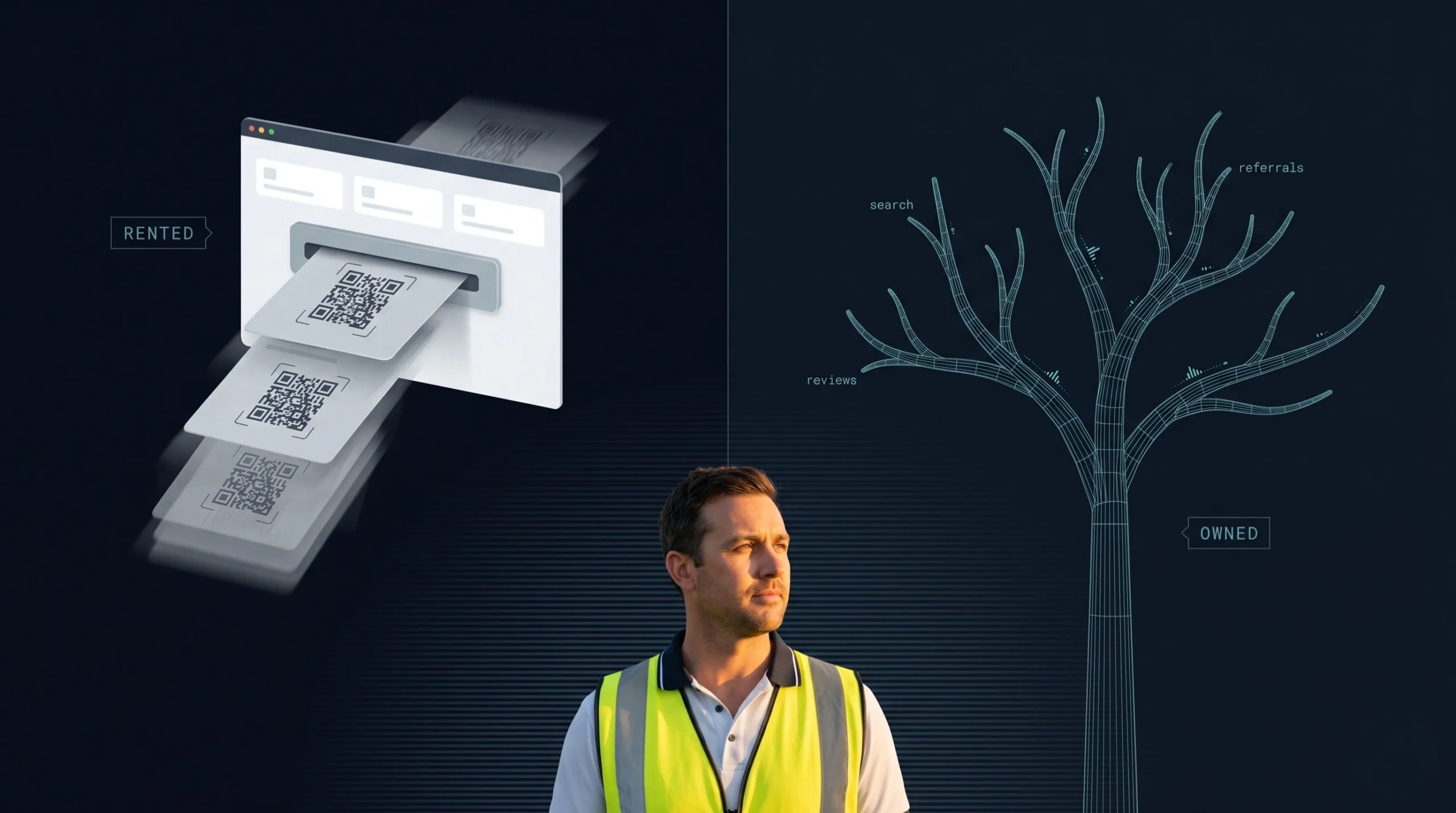
If you ring three HVAC marketing agencies in Australia today and ask whether you should buy leads or build your own pipeline, you’ll get three different answers – each one suspiciously aligned with whatever that agency happens to sell. The hipages reseller will tell you to buy. The SEO agency will tell you to build. The PPC shop will tell you “it depends.”
The honest answer is that neither one wins on its own. Buy to fill the calendar today. Build to own the calendar in 12 months. The Australian HVAC businesses that are growing fastest in 2026 are running both – but in a specific ratio that shifts as the business matures.
This is the comparison no one published with real Australian data. What buying actually costs vs what building actually costs, when each one wins, and the hybrid model that beats both.
Quick answer: Buying HVAC leads in Australia (hipages, Oneflare, Google LSAs) delivers immediate lead flow but at $200-$600 per booked job with shared-lead competition driving price down. Building your own pipeline (local SEO, Google Business Profile, content, referrals) takes 90-180 days but produces exclusive leads at $25-$90 per booked job once established. The 2026 winning strategy is a hybrid: 30-60% bought leads for cash flow, 40-70% built pipeline for compounding margin – with the ratio shifting toward owned channels as the business matures.
The Headline Comparison
| Buying Leads | Building Pipeline | |
|---|---|---|
| Speed to first lead | Same day | 90-180 days |
| Cost per lead | $30-$150 | $5-$30 (in steady state) |
| Close rate | 10-25% (shared) | 35-55% (exclusive) |
| Cost per booked job | $200-$600+ | $25-$90 |
| Lead exclusivity | Shared (up to 3 competitors) | 100% exclusive |
| What happens if you stop paying | Leads stop immediately | Pipeline keeps producing |
| Sellability impact | 1.5-2.5x EBITDA | 4-6x EBITDA |
| Best for | New businesses, gap-filling | Established businesses, scale |
When Buying HVAC Leads Is the Right Call
Buying leads through marketplaces (hipages, Oneflare, ServiceSeeking) or pay-per-lead channels (Google Local Services Ads) makes sense in three specific scenarios – and in only those three:
1. You Need Leads This Week, Not Next Quarter
A new HVAC business with no website authority, no Google Business Profile reviews, and no email database can’t wait six months for SEO to compound. Buying leads is the only way to fill the calendar while organic channels build.
Sensible spend: 60-70% of marketing budget bought, 30-40% invested into long-term assets from day one.
2. Filling Shoulder-Season Gaps
Late autumn and early spring are dead zones for residential HVAC in most of Australia. Topping up calendar capacity with bought leads (especially Google LSAs for emergency work) is more efficient than letting technicians sit idle.
Sensible spend: 20-30% bought lead spend during off-season only.
3. Entering a New Geographic Market
If you’re a Melbourne ducted heating installer expanding into Geelong or a Sydney air con business launching in the Central Coast, you need lead flow before your local SEO ranks. Buy through that 6-9 month window, then taper as your owned pipeline matures.
What to Avoid When Buying
- Long subscription lock-ins. The ACCC’s investigation of hipages‘ auto-renewal practices showed how easy it is to be trapped in 12-month commitments at $200-$999 per month
- Marketplace categories that show 4+ competitors per lead (race-to-the-bottom on price)
- Any “exclusive lead” provider that won’t show you their actual lead source (often scraped from your competitors’ Google Ads)
When Building Your Own Pipeline Is the Right Call
Building means investing in assets you own – your website, your Google Business Profile, your review profile, your customer database, your content. Each of these is a piece of digital real estate.
Bought leads are rented land – when you stop paying, the leads stop arriving. Built pipeline is owned land – once it produces, it keeps producing.
1. You're Past Survival Mode
If your business is generating $1M+ in annual revenue with stable cash flow, every dollar spent on owned channels compounds. A piece of suburb-targeted content written today will generate organic leads in 2027, 2028, 2029 – without paying again.
2. You Want to Control Your Margin
Bought leads have a price floor set by the platform. Owned leads have a price floor set by your operational cost. Once an HVAC business has 200+ Google reviews, top-3 Map Pack rankings in their service suburbs, and a 1,500+ customer database, the marginal cost of one more lead approaches zero.
3. You Want to Build Something Sellable
Australian HVAC businesses with strong owned pipelines sell for 4-6x EBITDA multiples. Businesses dependent on bought leads sell for 1.5-2.5x, because the buyer knows the lead flow disappears the moment they stop paying.
What Building Actually Requires
- Local SEO retainer – $1,200-$3,500 per month for managed SEO, typically 90-180 days to first rankings
- Content production – 4-8 long-form articles per month plus suburb landing pages
- Review velocity – 3-5 new Google reviews per week (automated review-request sequences)
- CRM and email infrastructure – for database reactivation; existing-customer marketing is the highest-margin lead source in HVAC
The 2026 Trends That Change the Answer
Two structural shifts in 2026 make the buy-vs-build maths different from 2024:
1. Speed-to-Lead Is Now a 5-Minute Window, Not 30
Multiple 2026 industry studies confirm what HVAC owners have suspected for years: leads contacted within 5 minutes convert 21x more often than leads contacted after 30 minutes. This favours owned channels because the lead lands directly in your CRM and triggers automated follow-up. Bought leads – especially marketplace leads – often arrive after a delay, by which time three competitors have already responded.
2. AI Changed the Cost of 'Always On'
24/7 AI call answering and AI-powered website tools that produce instant self-service quotes have collapsed the cost of being responsive at any hour. This makes owned channels dramatically more profitable in 2026 than 2024 because every lead a built pipeline generates can now be qualified, booked, and confirmed without human touch.
These two trends are why the 2026 hybrid ratio is shifting from 50/50 to 30/70 – bought leads for immediate flow, owned pipeline for everything else.
The Hybrid Strategy That Wins in 2026
| Business Stage | Recommended Ratio | Bought Channels | Built Channels |
|---|---|---|---|
| New business (0-12 months) | 60% bought / 40% built | Google LSAs, hipages | Google Business Profile, suburb pages, CRM setup |
| Growth (1-3 years, $500k-$2M) | 40% bought / 60% built | Google LSAs, Google Ads | Local SEO, content, review velocity, email |
| Established ($2M+) | 20% bought / 80% built | Google LSAs (emergency only) | Local SEO, database reactivation, referral programs |
The single biggest mistake Australian HVAC owners make is staying at the new business ratio for years after they’ve outgrown it. They keep paying hipages $500 per month and $60 per lead because “it works” – never noticing that 100% of the same budget redirected into local SEO would produce 3x the leads at 1/4 the cost-per-booked-job by year three.
What to Do This Week
- Calculate your real cost per booked job by channel. Not cost per lead – cost per booked job. The two diverge violently.
- Identify which bought channels are still profitable at your current close rate, and which are bleeding margin.
- Allocate 30-40% of your marketing budget to owned-channel investment even if you have to reduce bought-lead spend to fund it. Compounding only starts when you start.
- If you don’t yet have AI call answering, that’s the single highest-ROI move in 2026 – it boosts close rate on every lead source you already use, by 30-70%.
The right HVAC marketing partner won’t sell you bought leads or sell you SEO. They’ll build you a system where both work together – and where the bought-lead spend reduces every quarter as your owned pipeline scales.
Frequently Asked Questions
Is it better to buy HVAC leads or generate them organically in Australia?
Neither is better on its own – the optimal 2026 strategy is hybrid. Buy leads (hipages, Oneflare, Google LSAs) for immediate cash flow during the first 6-12 months or to fill shoulder-season gaps. Build owned pipeline (local SEO, Google Business Profile, content, referrals) for long-term margin and exclusivity. Most established Australian HVAC businesses run 20% bought / 80% built and see lower cost-per-booked-job than businesses relying on either channel alone.
How much do bought HVAC leads cost vs owned-pipeline leads?
Bought HVAC leads in Australia cost $30-$150 per lead with $200-$600 cost per booked job due to 10-25% close rates from shared-lead competition. Owned-pipeline leads (local SEO, Google Business Profile) cost $5-$30 per lead in steady state with $25-$90 cost per booked job at 35-55% close rates. Bought leads win on speed; owned leads win on margin and exclusivity.
Should new HVAC businesses buy leads or invest in SEO first?
New HVAC businesses should do both – but with a 60% bought / 40% built ratio for the first 6-12 months. Buying leads (particularly Google LSAs for their pay-per-lead model and Google Guaranteed badge) generates immediate cash flow. The 40% invested in owned channels (Google Business Profile, suburb landing pages, review velocity, CRM setup) starts compounding around month 4-6, allowing you to taper bought-lead spend by year 2.
Are hipages and Oneflare leads worth buying for HVAC contractors?
hipages and Oneflare can work for commercial HVAC tickets above $1,500 but rarely pencil out for residential service work under $600 in 2026. Each lead is shared with up to three contractors, pushing close rates to 10-25% and effective cost per booked job to $200-$600+. Subscription costs ($200-$600 monthly) and per-lead fees ($30-$80+) make the maths brutal unless you’re closing high-margin installations.
What's the biggest mistake Australian HVAC businesses make with lead generation?
The biggest mistake is staying at “new business” lead-buying ratios long after the business has outgrown them. An established Australian HVAC business spending $500+/month on hipages and $60/lead is leaving 3x the lead volume on the table compared to redirecting that same budget into local SEO, Google Business Profile optimisation, and database reactivation. The second-biggest mistake is tracking cost-per-lead instead of cost-per-booked-job – the two metrics often point to opposite decisions.