

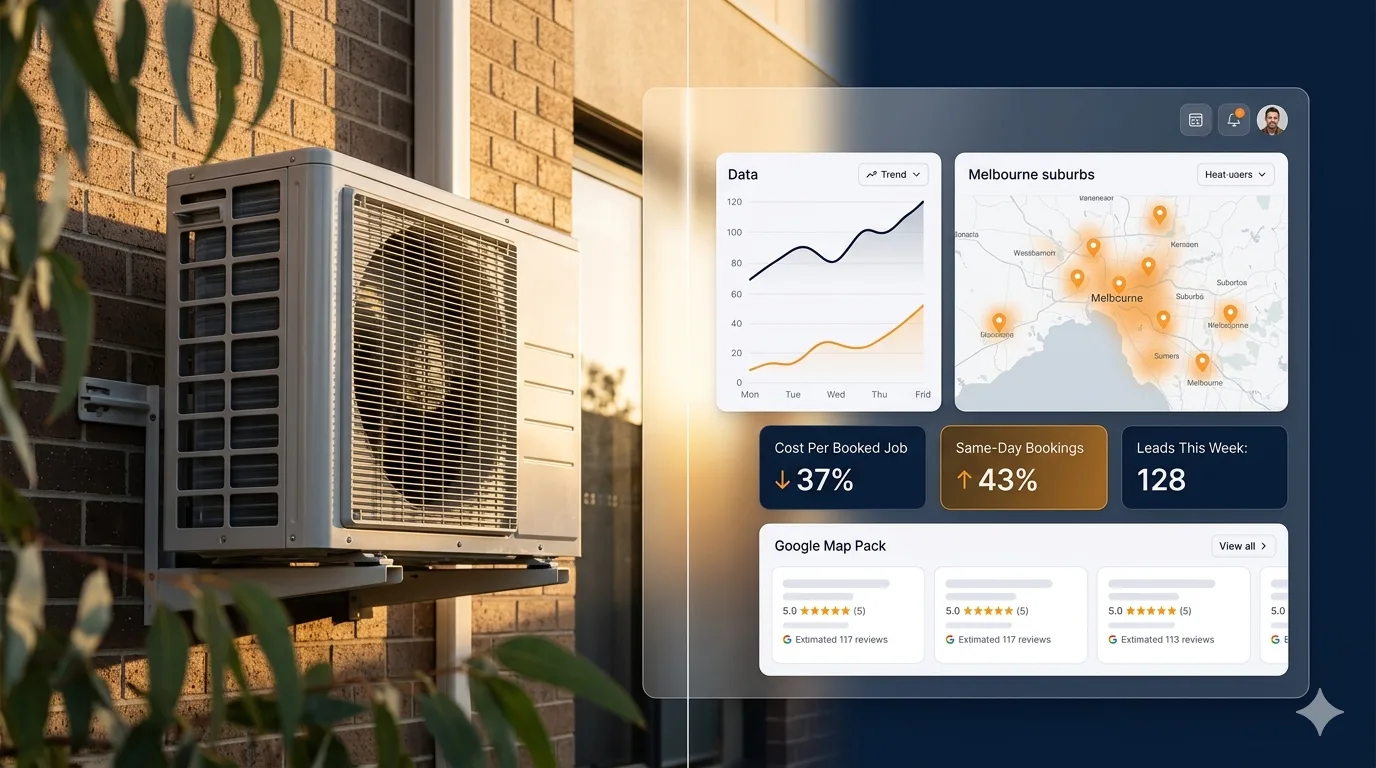
HVAC marketing agency for Australian heating and cooling businesses: Why generalist marketing is costing HVAC owners 40% more per lead and what actually fills the schedule.
If you run an HVAC business in Melbourne, Sydney, Brisbane or anywhere across Australia, you’ve felt it: labour costs up 18% in two years, lead aggregators eating your margin, and homeowners who now expect an instant price before they pick up the phone.
The old playbook ranking once a year, boosting a Facebook post, paying a generalist agency for “brand awareness” is actively losing money in 2026. Not because HVAC is a bad business. Because the game changed while the vans were on the road.
The commercial reality: If your marketing partner can’t name the last three refrigerant regulation changes that affect quoting, they’re costing you installations.
The 'Big 5' Agency Illusion: Built for Global Brands, Not HVAC Booking Sheets
The world’s five largest ad holding companies — WPP, Omnicom, Publicis, IPG and Dentsu — manage over $100 billion in annual spend. They excel at Super Bowl spots and quarterly earnings calls. None of that fills a van schedule in Dandenong on a Tuesday morning.
For an Australian HVAC business, partnering with a generalist agency is like hiring a commercial architect to replace a split system. The incentives are misaligned from day one:
KPIs that look good on a dashboard but don’t answer phones: Generalist agencies report “impressions” and “reach”. HVAC owners need cost-per-booked-job and conversion-to-dispatch. One without the other is expensive noise.
Zero integration with your real workflow: They don’t know ServiceM8 from Simpro. When lead data gets manually re-entered, you lose 15–20% of jobs to slow response times. That’s a structural flaw, not a tech issue.
Hidden markups and platform fees: Lock-in contracts and media margins obscure the true cost of a lead. In our experience auditing HVAC accounts, owners pay 30–50% more per lead through generalist resellers than through direct specialist management.
A real example: A Victorian HVAC owner recently showed us a $4,200/month Google Ads bill from a non-specialist agency. After stripping out branded search (which would have converted anyway) and mis-targeted display, the true cost-per-installation lead was $347 — nearly double the specialist benchmark of $180–$220.
“We used to pay $347 per installation lead with a generalist agency. Switched to Webco and we’re now at $198 with more booked same-day. Same spend, nearly double the jobs.”
— Mark T., HVAC business owner, South East Melbourne
3 Market Shifts That Just Made Generalist HVAC Marketing Dangerous
The digital lead landscape for Australian HVAC businesses has fractured. What worked in 2023 is actively losing money in 2026. Here’s what’s changed and why agility now beats scale.
1. Zero-click search and AI Overviews are bypassing generic content. Google now answers simple HVAC queries (“emergency air conditioning repair near me”) directly on the search page. Only HVAC businesses with deep local authority, review velocity and structured data still win the click. Generalist agencies rarely optimise for AI Overviews they’re still writing generic blog posts about “how to unclog a drain”.
2. Lead aggregators are arbitraging your brand. Without a specialist who understands negative keywords and campaign segmentation, you end up bidding against yourself. One Sydney HVAC group we audited had 22% of its ad spend competing with its own organic listings.
3. Customer behaviour has hardened. The average homeowner now expects a text response within 4 minutes, an upfront price range and Google-star validation before they call. If your marketing doesn’t feed directly into your booking system with instant confirmation, you lose them to the competitor who does. That’s not a customer service issue it’s a broken lead-to-job pipeline.
What Is HVAC Marketing? (And Why It's Different)
HVAC marketing is the specific set of digital strategies used to promote heating, ventilation and air conditioning businesses combining local SEO, paid search, seasonal campaigns, reputation management and CRM automation to convert high-intent searches into booked installation and service jobs.
Unlike general retail or B2B marketing, HVAC marketing is shaped by three realities that change the entire playbook:
Urgency. Customers usually need repairs immediately a failed aircon in a 38°C Melbourne heatwave is an emergency, not a research project. Response time beats brand.
Seasonality. Demand swings drastically between summer (cooling) and winter (heating). Agencies that don’t rebalance spend by season burn 25–40% of the annual budget on the wrong months.
High ticket value. A ducted system install can clear $12,000–$25,000. That requires trust-building content, reviews and a conversion path not a quick discount banner.
A proper HVAC marketing strategy balances generating immediate repair leads (high volume, lower margin) while building the brand authority needed to close lucrative system replacement contracts (low volume, high margin). Generalists optimise for one or the other. Specialists optimise for both.
1. Local SEO & Google Business Profile for HVAC Map Pack Visibility
Most HVAC customers search “air conditioning repair near me” or “ducted heating [suburb]”. The Google Map Pack is the #1 lead source for local HVAC service not the organic results below it.
Google Business Profile optimised for emergency keywords (“24hr air conditioning repair Eastern Suburbs”, “split system installer Parramatta”)
Suburb-level service landing pages one per service area, not a single “contact us” catch-all
Review velocity strategy Google ranks businesses with recent, relevant reviews higher than older static profiles
Outcome: Inbound calls from homeowners ready to book not tyre-kickers asking for a ballpark over email.
2. Google Local Services Ads (LSA) with the 'Google Guaranteed' Badge
Local Services Ads sit above standard Google Ads and carry the “Google Guaranteed” trust badge. They’re pay-per-lead, not pay-per-click making them the single highest-ROI channel for most Australian HVAC businesses in 2026.
Verified LSA profiles with licence, insurance and background-check evidence uploaded correctly
Dispute management for off-target leads so you only pay for genuine HVAC enquiries
Call tracking tied to your CRM so every LSA lead is measured against cost-per-booked-job
Outcome: Premium placement, pre-qualified leads, predictable cost-per-acquisition often 30–50% cheaper than standard Google Ads for the same installation keywords.
3. Seasonal PPC Campaigns Timed to Australian Weather Patterns
Smart HVAC PPC doesn’t spend evenly across the year. It front-loads spend 4–6 weeks before each seasonal spike to capture planning traffic, then scales hard during peak demand.
Heating campaigns ramp April–May for winter install demand (Victoria, NSW, ACT, Tasmania)
Cooling campaigns ramp October–November ahead of summer, with geo-weighting to Queensland, WA and inland hot zones
Emergency call-only ads run 24/7 with hour-of-day bid modifiers for heatwaves and cold snaps
Outcome: Ad spend flows to the months that actually convert. Idle vans disappear. Cost-per-lead drops 20–35% versus flat annual campaigns.
4. Reputation Management: Reviews as a Growth Asset
In HVAC, a 4.8-star rating is often the deciding factor between you and the next quote on the homeowner’s shortlist. Every 5-star review is an asset that pays dividends in lower ad costs and higher close rates.
Automated review request sequence triggered after every completed job via SMS and email
Response management on Google, Facebook and Product Review including negative reviews (the handled ones convert readers better than untouched 5-stars)
Schema markup so review stars appear in organic search results, not just on your profile
Outcome: Higher click-through from search, lower cost-per-lead across every paid channel, and a trust moat competitors can’t buy.
5. CRM & Email Automation for Maintenance Reminders and Re-Engagement
Every HVAC customer is a $500–$2,000/year maintenance annuity if you stay in front of them. Most businesses collect the job, invoice it, and never email the customer again. That’s leaving recurring revenue on the table.
Annual filter clean and safety check reminders timed to the season after install
Stalled-quote revival sequences 30% of quotes that went cold can be recovered with the right follow-up cadence
Past-customer reactivation for system upgrades 8–12 years post-install, when replacement becomes viable
Outcome: Lifetime customer value rises 40–80% without a single extra ad dollar. One-off repair customers become recurring maintenance clients and future replacement sales.
How Much Does HVAC Marketing Cost in Australia?
HVAC marketing in Australia typically costs between $3,500 and $10,000+ per month depending on your growth goals, service area and channel mix. Here are the realistic investment ranges for a Melbourne, Sydney or Brisbane HVAC business in 2026:
Local SEO & content marketing: $1,500–$3,500 AUD per month. Long-term compounding growth; 3–6 months to mature.
Google Ads and LSA (management + ad spend): $2,000–$5,000+ AUD per month. Immediate leads; costs stop when ads stop.
High-conversion website build: $3,000–$10,000+ AUD one-time. A fast, mobile-first site is non-negotiable for HVAC conversion.
CRM, review and automation stack: $300–$800 AUD per month depending on integrations.
A note on cheap packages: “Set-and-forget” HVAC marketing bundles under $1,500/month almost always waste ad spend on broad-match keywords, branded search you’d have won anyway, and untracked phone leads. A dedicated specialist fee keeps your cost-per-lead (CPL) low through constant optimisation which is the only metric that matters.
The Webco HVAC Marketing Difference
Webco isn’t the biggest agency in Australia. We’re the most focused. We work exclusively with Australian service trades — with heating and cooling (HVAC) as a core vertical. That means our tech stack, reporting language and optimisation playbook are calibrated for one outcome: more booked HVAC jobs at a predictable cost.
Here’s how the Webco HVAC Growth System works step by step.
Step 1 — Attract the right HVAC leads, not price-shoppers. We target high-intent searches tied to your service areas, weather spikes and urgent-repair windows. No spend on general traffic or curiosity clicks. Result: a pipeline of homeowners and property managers ready to say “yes” immediately.
Step 2 — Build a booking engine, not a brochure. Your website should be your hardest-working technician. We build mobile-first pages engineered for sub-2-second load times, click-to-call above the fold and forms that remove friction. One HVAC client lifted same-day booking rate by 43% with just a page restructure.
Step 3 — 24/7 AI call and text answering. Most HVAC revenue leaks within five minutes of a missed call. Our intelligent voice and text system bridges that gap after hours, weekends, public holidays. It books the job on the spot, before the prospect calls your competitor.
Step 4 — CRM automation that tracks first click to final invoice. Average response time drops from 12 minutes to under 90 seconds. Conversion lifts 25–40% without a single extra ad dollar. We report transparent cost-per-lead by suburb and service line so you know exactly what a split-system install lead costs in Bentleigh versus Brunswick.
What you won’t get: blended averages, hidden platform fees or 12-month lock-in contracts.
How to Choose the Right HVAC Marketing Agency
Not every agency that claims HVAC experience has actually generated an installation lead. Use these four filters before you sign anything:
Proven HVAC results: Ask for case studies specifically from heating and cooling businesses, not “trades” generally. Numbers should include cost-per-lead and cost-per-booked-job.
Clear, written strategy: They should be able to explain in plain English exactly how a lead becomes a booked installation channels, tracking, handoff, follow-up.
Transparent reporting: You should know where every dollar goes. If they can’t show you which suburb delivered this week’s leads, they’re flying blind.
ROI focus, not vanity: Leads and booked revenue not impressions, traffic, or “engagement”. Any agency that reports without revenue attribution is reporting to protect itself, not to grow your business.
Ready to Turn HVAC Searches into Booked Jobs?
You don’t need more technicians. You don’t need cheaper parts. You need a lead system that works while you sleep and a growth partner who understands how HVAC businesses actually make money.
At Webco, we don’t do vanity metrics. We build local search strategies that deliver weekly calls, booked installations and predictable revenue growth for Australian heating and cooling businesses. More visibility. Better leads. Stronger margin.
We’ll audit your current HVAC lead-to-job gap in 15 minutes. No fluff. Just a clear number: how many more booked jobs you’d get with the same spend.